- Issue: Manual calculation of hours, overtime and overtime is time-consuming and the source of salary slip discrepancies.
- Key rules: Maximum of 8 hours per day and 44 hours per week (6 and 36 for hard and harmful), overtime with 40% extraordinary, night work 35% and Friday work as overtime.
- Solution: Daily recording of operation, periodic comparison with receipt and keeping track of all changes in a system.
- Role of Axis Puls: the program and its changes are provided to the administrator in a system of recording and reporting the functionality according to the access.
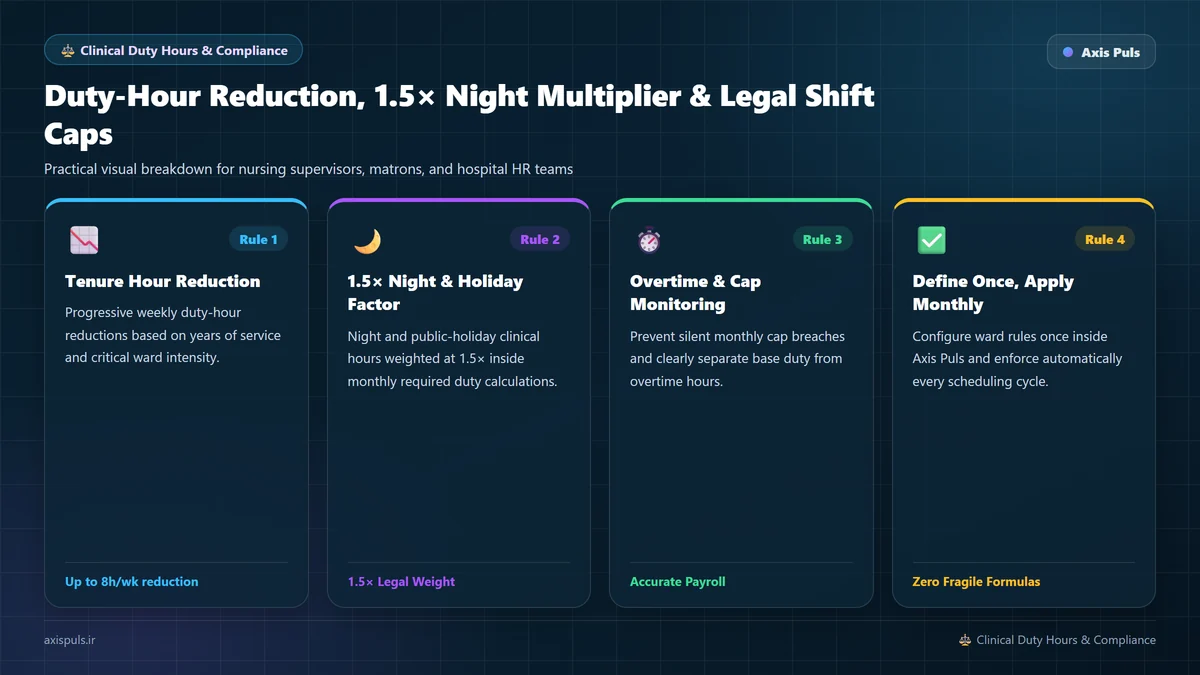
The working hours limit according to Iran's labor law
Tracking mandatory hours, rest windows, and fair night/holiday rotations is what separates a calm workplace from constant month-end payroll disputes. In this 5-minute guide, explore practical scheduling rules alongside our live Shift Arranger demo.
Tracking mandatory hours, rest windows, and fair night/holiday rotations is what separates a calm workplace from constant month-end payroll disputes. In this 5-minute guide, explore practical scheduling rules alongside our live Shift Arranger demo.
Overtime formula with an extraordinary 40%
According to the labor law, to every hour of overtime 40% extra on the normal hourly wage is awarded; That is:
Wage for each hour of overtime = Wage for one normal hour x 1.4
| Work-Hour & Shift Factor | Manual Sheets & Paper Logs | Structured Control in Axis Puls |
|---|---|---|
| Daily & Monthly Hour Caps | Added up by hand at month-end after overtime already happened | Checked live for each worker while building the roster |
| Night & Holiday Rotation | Unintentional pile-ups on reliable staff trigger resentment | Capped, transparent rotation visible before sign-off |
| Minimum Rest Between Shifts | Depends on visual memory under deadline stress | Automatic block on unsafe back-to-back or night-to-morning turns |
| Leave & Cover Requests | Scattered chats that desync from the wall printout | Centralized request trail with eligible replacement suggestions |
Excellent night work, shift work and Friday work
In addition to overtime, the other three are very common in shift schedules. first, night work: Work in the hours between 22:00 and 06:00 for non-shift workers. 35% overtime has Second, shift work: Shift workers receive 10-22.5% overtime depending on the mix of their shifts (10% morning and evening, 15% morning and evening and night, 22.5% morning and night or evening and night). Its industrial details in the article Shift workers has come
Third, Friday work: Friday is a weekly holiday and work on this day is considered overtime; It means that it is subject to the same 40 percent. Practical tip: In shift schedules where Friday is the normal working day of the cycle, it should be clear in advance what the situation is on Friday so that there are no differences at the end of the month. General rule: any rule written and not announced in advance, the end of the month will not be interpreted in favor of anyone; Write and publish.
Rest time, lunch and leave in the calculation of hours
As a general rule, Resting and eating time are not considered mandatory working hours, unless it is provided otherwise in the contract or agreement between the employer and the worker. For this reason, it should be clear in the schedule and contract how much is the daily rest period and whether the work component is calculated or not; Ambiguity in this small point becomes a big difference on the scale of months and years.
The same rule applies to leave: paid leave, sick leave and unpaid leave, each of them has a different effect on work and rights and must be recorded with a document. request Leave and assignment of shifts It is registered in the same system and after confirmation, the program is updated according to the new status; That is, the effect of leave on performance remains clear and traceable. For general principles of fair arrangement of turns, see Esq Shift adjustment read the
| Real User Situation | Common Emotional Trap | Sustainable Practical Response |
|---|---|---|
| Falling behind by mid-afternoon | Doubling tomorrow's workload and burning midnight oil | Prune low-value tasks immediately and rescue 1–2 core items |
| Setting monthly or quarterly goals | Writing vague wishes like 'get organized' with no calendar slot | Break each goal into concrete weekly milestones on your timeline |
| Running meetings or group plans | Open-ended calls with no agenda, owner, or stop time | Attach a 3-bullet agenda, hard end time, and action checklist |
| Choosing planning software | Juggling four complex apps until tool fatigue wins | Keep daily tasks, Eisenhower priority, and shifts in one place |
According to Iran's labor law, normal working hours 8 hours a day and 44 hours a week is This means that the standard weekly schedule (eg Saturday to Wednesday full time and Thursday part time) should not exceed 44 hours in total; Every working hour in excess of this ceiling, overtime is considered For hard and harmful work, the ceiling is lower: 6 hours a day and 36 hours a week; Because burnout occurs faster in these jobs and the law provides more protection.
Two basic concepts should be separated. duty hours, is the minimum time commitment of the individual in the period (eg months) to be covered. overtime overtime hours and work deficit The hours are less than that. At the end of each period, each person's actual performance should be measured by these three numbers: how much was owed, how much was added, and how much was recorded as a deficit. When these numbers are registered and visible, the legal debate will return to the number. For the treatment staff whose duty limit is subject to the Law of Productivity Promotion, article Nurses shift see
Educational example: if a person's normal hourly wage is 100 thousand tomans, each overtime hour is calculated as 140 thousand tomans. (The numbers are just to understand the formula.)
Important note for managers: Overtime must be done Ceiling and license have Overtime without a ceiling makes both the cost unpredictable and leads to wear and tear and quality loss. The correct rule is that the need for overtime work should be predicted and recorded in advance, the monthly limit of each person should be specified, and payment should be made based on the recorded work; No guesswork or verbal agreement. About registration and control of this process, article Shift control read the
To connect this workflow with adjacent tools and real examples, explore Live Shift Arranger Demo, Smart Shift Management, HR Management, Clinical Productivity Law, Work Shift Adjustment, Shift Control.
❓ Frequently Asked Questions from Real Workflows
Transparent operation, plug without difference
Try for two months in the real conditions of your collection and then decide.
Start of trial periodOr test a simulated ward right now without signing up in the Live Interactive Shift Arranger Demo.