- Issue: An empty shift makes the line fall asleep, fatigue creates an accident, and shift calculation is a place for salary disputes.
- Solution: Shift pattern according to the line (two, three shifts or four groups), compliance with the 44-hour limit, 10 to 22.5% extraordinary actions and legal arrangement with centralized registration.
- Result: A non-stop line, a defensible paycheck and a fair distribution of night work.
- Axis Puls role: shifts and capacities are defined and arranged on the same basis once and approved by the manager.
Shift management in factory and production line
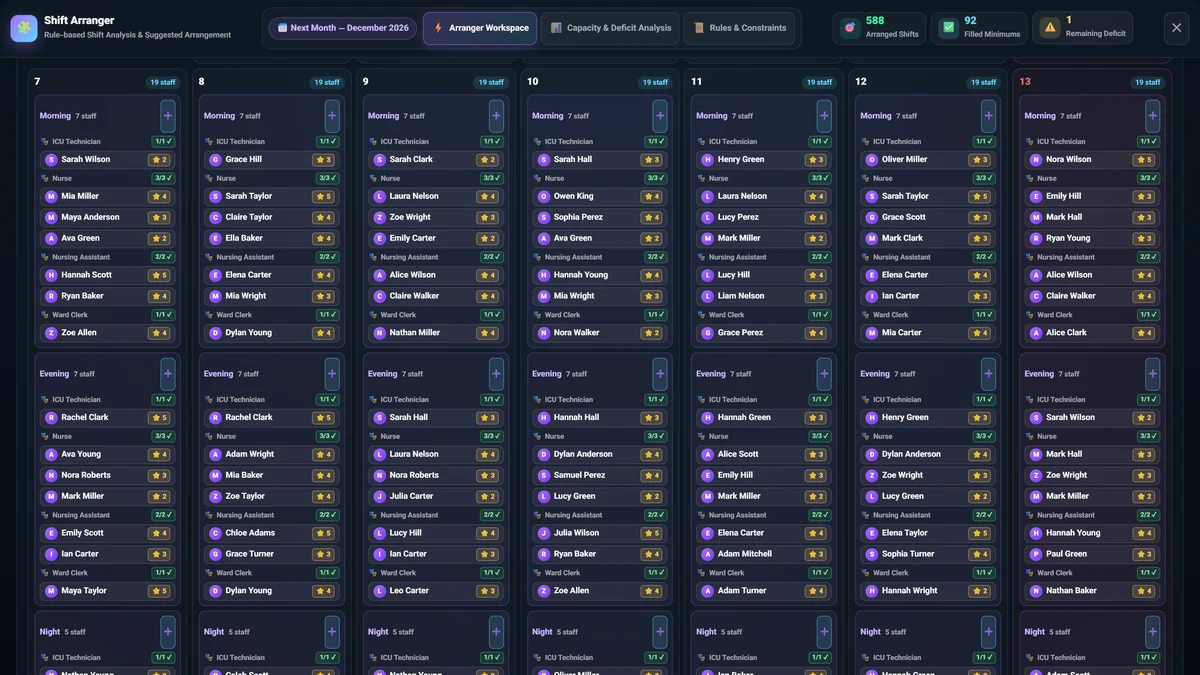
Tracking mandatory hours, rest windows, and fair night/holiday rotations is what separates a calm workplace from constant month-end payroll disputes. In this 5-minute guide, explore practical scheduling rules alongside our live Shift Arranger demo.
Tracking mandatory hours, rest windows, and fair night/holiday rotations is what separates a calm workplace from constant month-end payroll disputes. In this 5-minute guide, explore practical scheduling rules alongside our live Shift Arranger demo.
Extraordinary shift work and the limit of hours according to the labor law
According to Iran's labor law, normal working hours are 8 hours a day and 44 hours a week and for hard and harmful work 6 hours a day and 36 hours a week. Additional hours are considered overtime, the rate of which is 40% higher than the normal hourly wage. Full details of calculations in the article Working hours read; Here we focus on shift work.
Shift super is an amount in excess of wages paid to shift workers, the percentage of which depends on the mix of shifts: 10 percent Wages for mixed morning and evening work, 15 percent To combine morning and evening and night, and 22.5 percent To combine morning and night or evening and night. In addition, night work (hours between 22:00 and 06:00) for off-shift workers has a 35% overtime. These percentages must be clear and verifiable in the pay slip; When the basis of each person's turn is recorded and visible, the discussion of "my turn was undercounted" returns to the number.
| Work-Hour & Shift Factor | Manual Sheets & Paper Logs | Structured Control in Axis Puls |
|---|---|---|
| Daily & Monthly Hour Caps | Added up by hand at month-end after overtime already happened | Checked live for each worker while building the roster |
| Night & Holiday Rotation | Unintentional pile-ups on reliable staff trigger resentment | Capped, transparent rotation visible before sign-off |
| Minimum Rest Between Shifts | Depends on visual memory under deadline stress | Automatic block on unsafe back-to-back or night-to-morning turns |
| Leave & Cover Requests | Scattered chats that desync from the wall printout | Centralized request trail with eligible replacement suggestions |
Two-turn, three-turn and four-group patterns
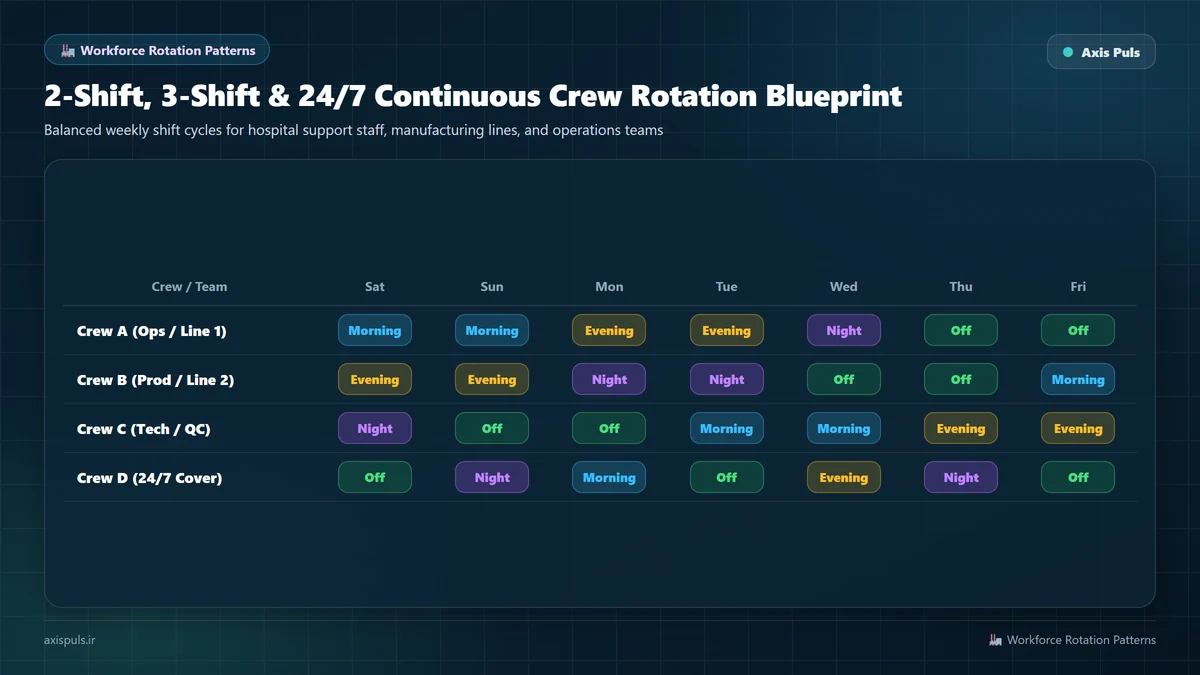
The choice of pattern depends on the continuity of the line. Two shifts (morning and evening) is for workshops that are closed at night; The simplest model with the least computational complexity. Three shifts (morning, evening, night) is for round-the-clock coverage with three groups and requires regular night rotation between groups so that the burden does not fall on one team. Four groups For continuous lines, there is no break: four teams cover the line in rotation, and one team is always at rest; A template that automatically resolves holiday coverage.
Morning and evening for the workshop with night closure; Simple and less challenging.
From shift office to legal layout with Axis Puls
The difference between the shift office and the system, in Regularity and footprint is in Axis Puls, the set structure, roles, turns and capacities of each shift are defined once in the system; The staff are entered with the department's specific code and their role is confirmed by the manager; The requests are registered in the system and checked with the same rules, and the layout is done on the same basis. The manager checks the output and makes the final approval himself.
For daily changes request Leave and assignment of shifts It is registered in the same system, eligible people are identified and suggested, and after approval, the program is updated; That is, a sudden absence does not mess up the entire table by hand. If a turn cannot be completed with the defined conditions, the system notifies the manager instead of ignoring the rule. Industrial complexes can test their line for two months in real conditions and compare parameters such as empty turns, line stoppages, and chip discrepancies before and after.
| Real User Situation | Common Emotional Trap | Sustainable Practical Response |
|---|---|---|
| Falling behind by mid-afternoon | Doubling tomorrow's workload and burning midnight oil | Prune low-value tasks immediately and rescue 1–2 core items |
| Setting monthly or quarterly goals | Writing vague wishes like 'get organized' with no calendar slot | Break each goal into concrete weekly milestones on your timeline |
| Running meetings or group plans | Open-ended calls with no agenda, owner, or stop time | Attach a 3-bullet agenda, hard end time, and action checklist |
| Choosing planning software | Juggling four complex apps until tool fatigue wins | Keep daily tasks, Eisenhower priority, and shifts in one place |
Layout shift workers It directly affects two things: Continuation of production and Safety. Unlike office work where one person's lateness can be compensated, in the production line the absence of a key operator can stop the line and the fatigue of a tired worker can lead to an accident. For this reason, the industrial shift work program has three conditions at the same time: full coverage of each shift with the right skill combination, compliance with the legal limits of work and rest, and accurate calculation of supernumeraries so that the salary slip is not a point of dispute.
In many workshops, the program is still arranged with a notebook and a shift mind; The method works as long as the number of staff is small, but with the growth of the line, the addition of night shifts and shift work rules, it leads to differences and rework. The solution, the same structured path Shift Management In this article you will read the industrial version of it: from turn patterns to legal supers.
To connect this workflow with adjacent tools and real examples, explore Live Shift Arranger Demo, Smart Shift Management, HR Management, Clinical Productivity Law, Work Shift Adjustment, Shift Control.
❓ Frequently Asked Questions from Real Workflows
Arrange the production line without empty turns and without differences
Try for two months in the real conditions of your collection and then decide.
Start of trial periodOr test a simulated ward right now without signing up in the Live Interactive Shift Arranger Demo.