
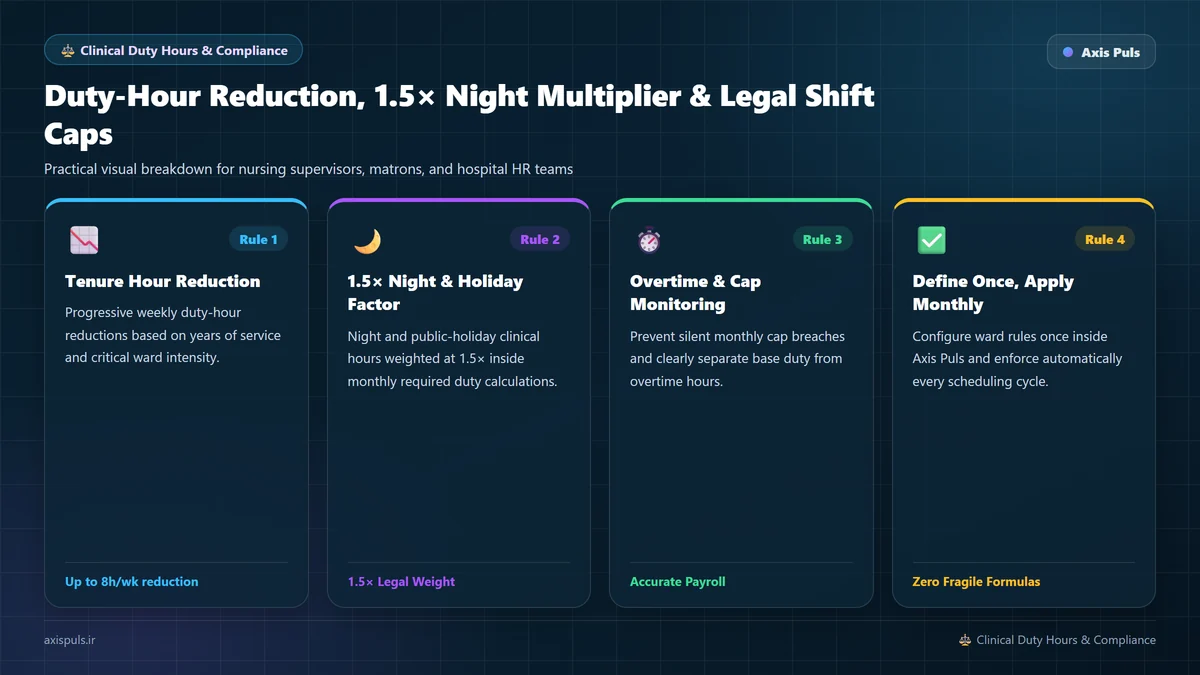
- The productivity law aims to cut clinical staff duty hours from 44 to as low as 36 hours a week, compensating for unsocial-shift fatigue.
- The 1.5× factor for night shifts and holidays plus special-ward hardship makes manual scheduling highly complex and error-prone.
- Smart systems like Axis Puls compute all seniority, shift and overtime coefficients automatically and instantly.
Why the clinical staff productivity law was passed
Calculating seniority hour reductions and 1.5x night or holiday multipliers by hand across dozens of clinical staff turns every month-end into an error-prone marathon. This concise guide shows how to embed clinical hour rules directly into monthly roster building.
Clinical work in care centers is inherently exhausting. Constant exposure to critical patients, life-saving stress, repeated night wakefulness and long hours standing at the bedside wear clinicians down physically and mentally. That is why the parliament and the Ministry of Health passed the clinical staff productivity law — cutting working hours and granting restorative coefficients to guarantee care quality.
Formulas for cutting clinical duty hours
Weekly duty hours for covered staff (44 hours at baseline) shrink by up to 8 hours a week across 3 key variables:
Wards are ranked in 3 hardship tiers. Staff in high-pressure wards such as burns, psychiatry, ICU, CCU, emergency and operating rooms enjoy up to 3 hours' weekly reduction.
- 1–6 years of service: half an hour a week deducted.
- 7–12 years of service: 1 hour a week deducted.
- 13–18 years of service: 1.5 hours a week deducted.
- 19+ years of service: 2 hours a week deducted.
| Legal / Scheduling Factor | Effect on Monthly Roster | Common Spreadsheet Mistake | Structured System Control |
|---|---|---|---|
| 1.5x Night & Official Holiday Factor | Each night/holiday hour counts as 1.5 mandatory hours | Counting raw hours 1:1 until end-of-month payroll shock | Live cap tracking during roster generation |
| Seniority & High-Acuity Reductions | Mandatory weekly hours differ per nurse and ward | Applying one flat cap to every nurse | Per-role and per-person hour limits defined once |
| Post-Night Recovery Window | Blocks morning placement right after a night shift | Overlooked during mid-month manual edits | Automatic block on night-to-morning transitions |
| Auditability & Staff Trust | Objective count of nights, holidays, and total hours | End-of-month disputes over perceived bias | Transparent distribution summary before sign-off |
Supervisors' nightmares in traditional Excel planning
With a 30-nurse ward where everyone has different seniority, some work special wards, some work nights, and partial leaves overlap, manual Excel math faces deadly challenges:
- Unwanted overtime-cap breaches: a calculation slip can push a nurse past 80 overtime hours — a legal violation.
- Repeated night-hour disputes: with opaque formulas, staff usually assume their hours were undercounted.
- Performance vs. payroll mismatch: hand-carrying hours from Excel into HR and finance systems creates financial discrepancies.
- 1–6 years of service: half an hour a week deducted.
- 7–12 years of service: 1 hour a week deducted.
- 13–18 years of service: 1.5 hours a week deducted.
- 19+ years of service: 2 hours a week deducted.
- Unwanted overtime-cap breaches: a calculation slip can push a nurse past 80 overtime hours — a legal violation.
- Repeated night-hour disputes: with opaque formulas, staff usually assume their hours were undercounted.
- Performance vs. payroll mismatch: hand-carrying hours from Excel into HR and finance systems creates financial discrepancies.
- Automatic staff-seniority detection with smart weekly and monthly duty deduction.
- Instant 1.5× factor the moment staff land on a night shift or a national-calendar holiday.
- Color alerts as staff approach the duty cap, blocking repeated heavy shifts.
- Transparent performance slips visible in the nurse's mobile app for full calm and clarity. When every nurse sees exactly how their cap, factors and overtime were computed — line by line — payslip disputes practically vanish, and payroll closes days earlier each month.
Full worked example: from a raw rota to a final payslip
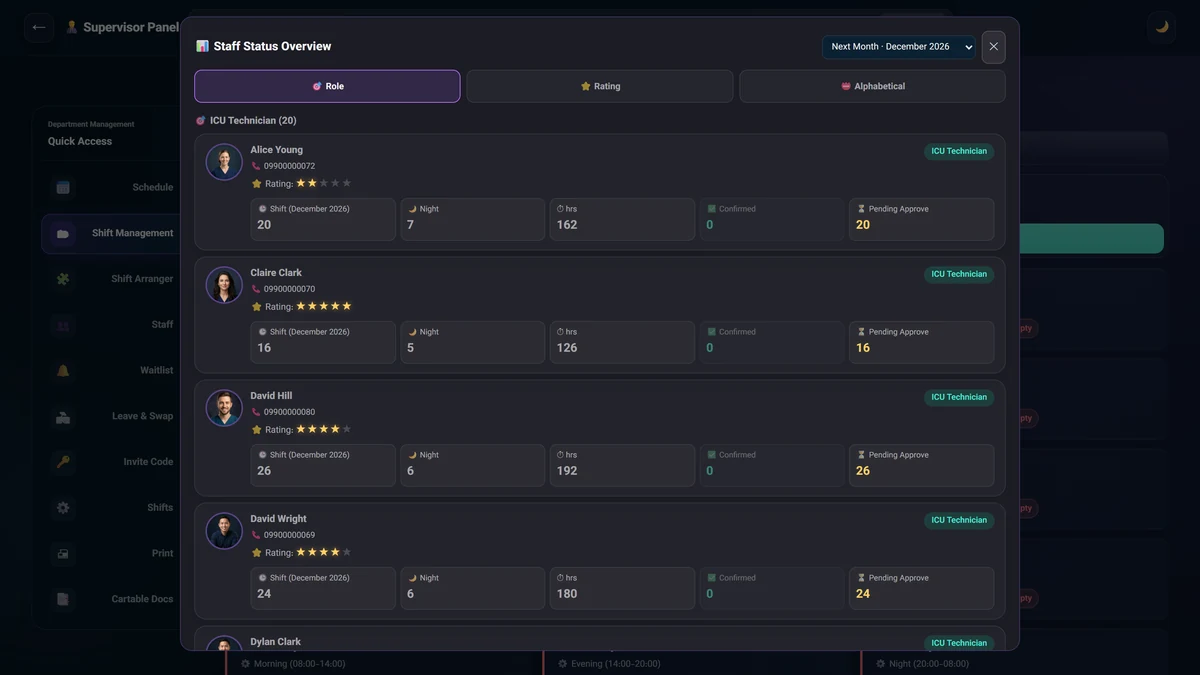
The law becomes tangible with numbers. Consider Ms. Ahmadi, a medical-ward nurse with 8 years of seniority who worked twenty-four 12-hour shifts in Mehr: 14 days, 7 nights and 3 holidays (2 of which were also nights). Without factors that is 288 hours — but the productivity law reads that raw number very differently.
Seven night shifts mean 84 hours counted at 1.5× = 126 hours. Three holidays (36 hours) likewise become 54. But the 2 shifts that were both night and holiday get factored only once (24 → 36 hours) — the classic manual-Excel mistake is factoring them twice, or missing them entirely. The compliant total: 168 plain day hours + 126 night hours + 18 extra non-night holiday hours = 312 equivalent duty hours.
| Hospital Role | Core Monthly Priority | Manual Bottleneck Today | Practical Outcome in Axis Puls |
|---|---|---|---|
| Shift Nurse / Staff | Predictable schedule and fair night rotation | Sending WhatsApp notes with no confirmation trail | Submit ranked preferences and track approval status |
| Head Nurse (Ward Lead) | Safe coverage across every shift without conflicts | Days spent rebuilding spreadsheets after one leave | Define ward rules once, generate drafts fast, sign off |
| Matron (Nursing Director) | Cross-ward balance and overtime visibility | Chasing mismatched Excel sheets across 10+ wards | Unified multi-ward oversight and clean sign-off trail |
| Hospital / HR Director | Compliance, cost control, and staff retention | Late attendance reconciliations and payroll disputes | Role-based access, audit logs, and verified monthly rosters |
In practice, though, precise clause-by-clause execution falls on hospital matrons and supervisors, who must compute and set complex tables of variables every month with no automated tools. Supervisors who track duty tables, night factors and hardship tiers in one structured roster spend far less time reconciling monthly schedules and can defend every assignment with documented figures.
Staff regularly on rotating shifts (morning, evening, night) receive up to 3 hours' deduction proportional to their unsocial shifts.
One of the law's most important clauses is the 1.5× factor: every hour worked during night shifts (usually 7 p.m. to 7 a.m.) and on official holidays counts as 1.5 duty hours.
For example, a 12-hour night shift counts as 18 duty hours in the monthly performance sheet. The factor lets nurses reach the monthly cap faster and prevents dangerous, exhausting overtime.
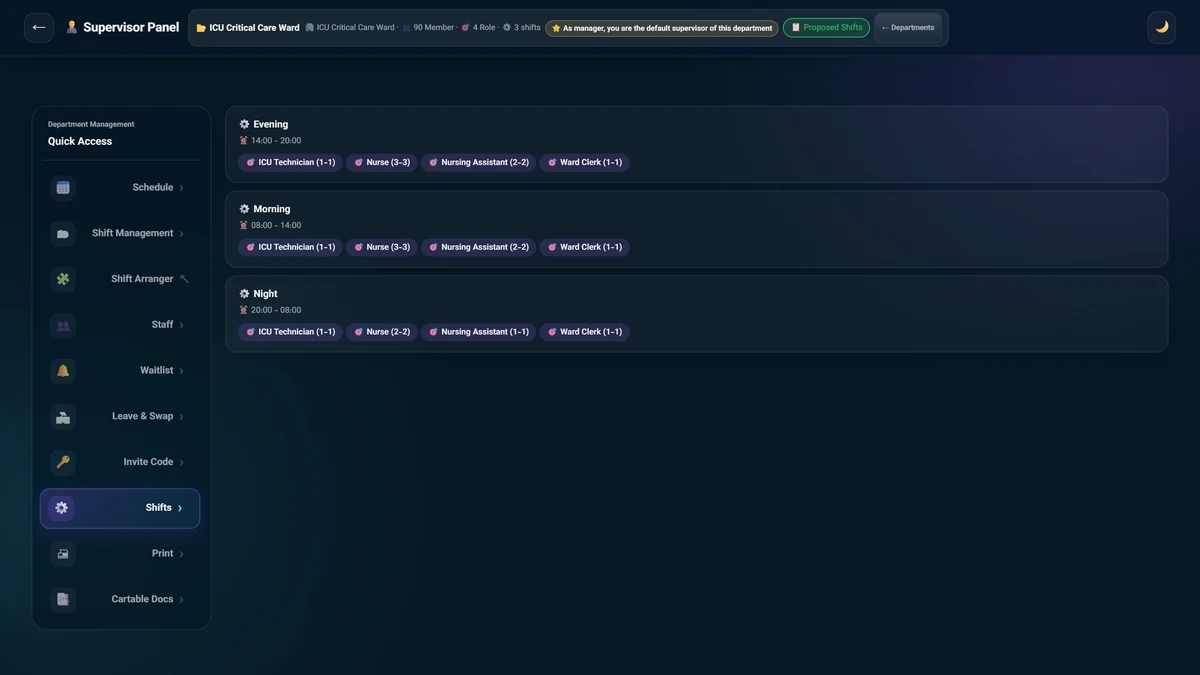
In the Axis Puls shift management platform, every Ministry table and directive is coded as optimization logic:
To connect this workflow with adjacent tools and real examples, explore Live Shift Arranger Demo, Nurse Shift Guide, Head Nurse Software, Matron Oversight Guide.
❓ Frequently Asked Questions from Real Workflows
Start your hospital's error-free scheduling
With Axis Puls, compute every productivity-law coefficient automatically — no Excel needed.
Log in and register free with Axis PulsOr test a simulated ward right now without signing up in the Live Interactive Shift Arranger Demo.
Disclaimer: this article is educational content on employment regulations; always check the current Ministry of Health directives for staffing decisions.
Sources
- World Health Organization — Health workforce: who.int — health workforce
- Specialist productivity & AI blog
- Hospital shift management
- Shift rules & capacity