- Problem: nursing shifts must simultaneously cover 24 hours, honor the productivity law, mix experience and manage fatigue — work that takes days by hand.
- Solution: define ward rules once, honor the 1.5× night and holiday factor, rotate nights fairly, and register requests and swaps centrally.
- Result: a defensible plan against objections, less pressure on head nurses, transparency for all staff.
- Axis Puls role: per product docs, each ward's rules are defined once and applied in every arrangement, with managers making final approval.
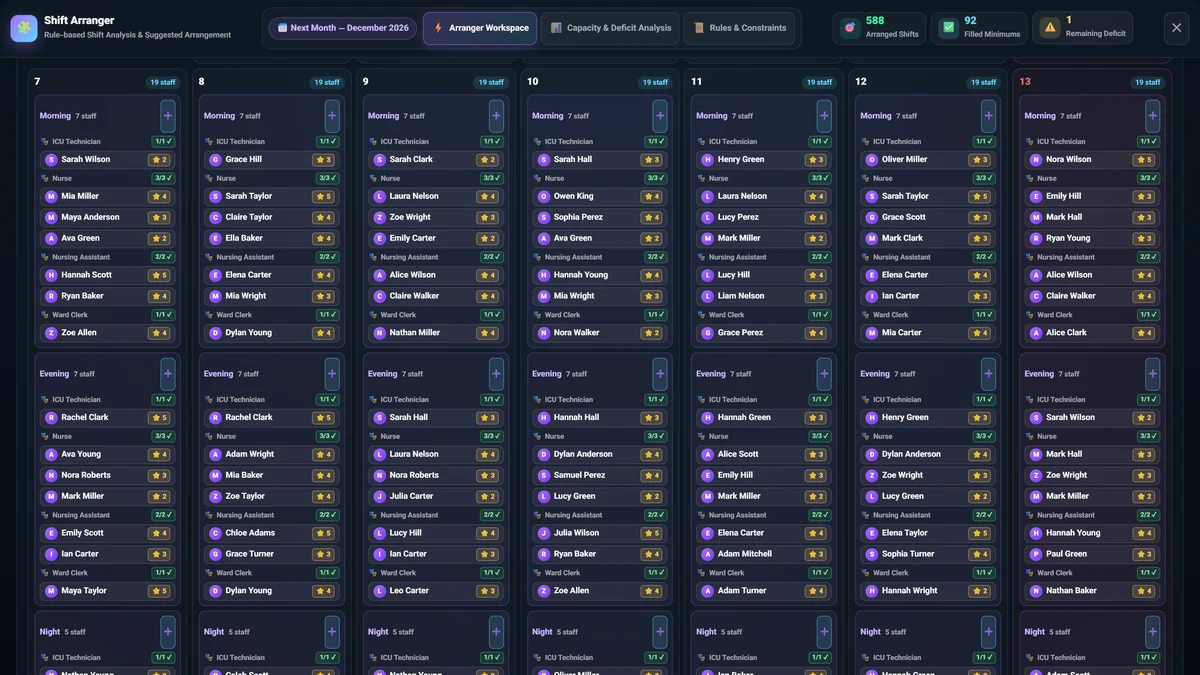
Why is nurse shift management more sensitive?
Calculating seniority hour reductions and 1.5x night or holiday multipliers by hand across dozens of clinical staff turns every month-end into an error-prone marathon. This concise guide shows how to embed clinical hour rules directly into monthly roster building.
Nurse shift management is the backbone of nonstop hospitals, emergency rooms and intensive care wards. Unlike office settings, we deal with vital urgency, direct stress and round-the-clock shifts; the smallest coverage gap in a shift can affect care quality. That is why nursing arrangement carries four simultaneous constraints: continuous, sufficient cover per shift, honoring clinician-specific rules, experience mix (senior alongside junior staff in every shift) and fatigue management.
The productivity law and night & holiday factors
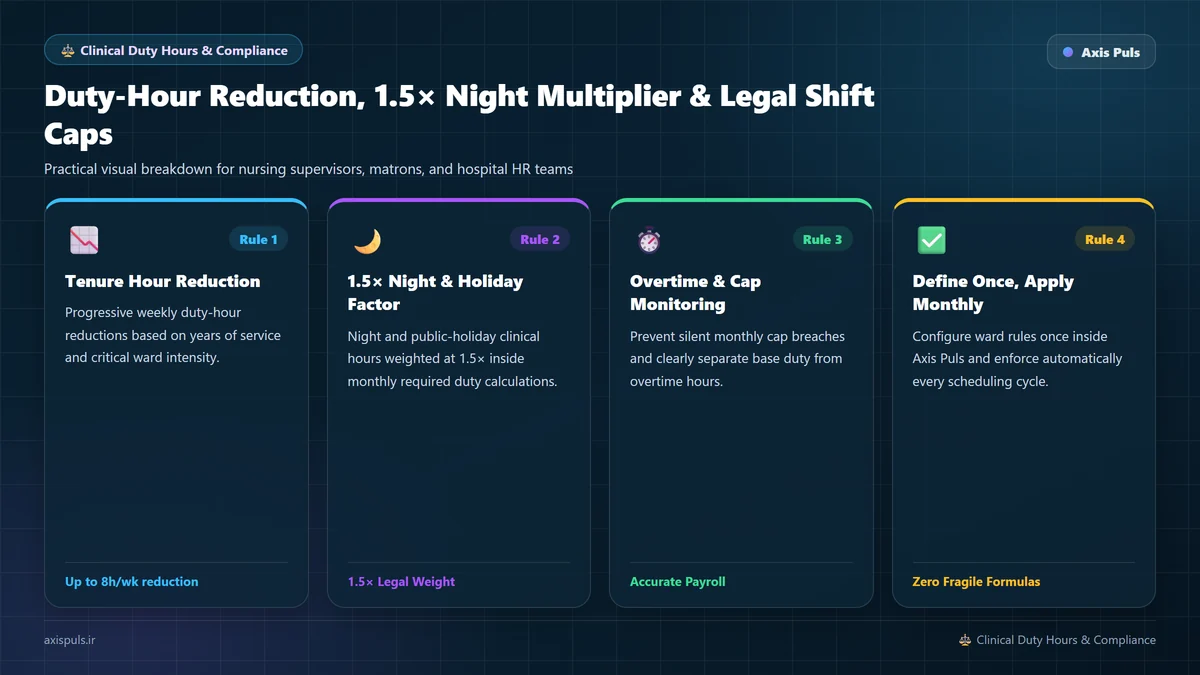
The most complex constraint of nursing shifts in Iran is the “clinical staff productivity law”. Every ward planner must know its two pillars. First, duty-hour reduction: weekly duty hours shrink by seniority and ward hardship; no two people share the same cap, and each must be honored individually. Second, the 1.5× factor for nights and holidays: every service hour on night shifts or official holidays counts as 1.5 duty hours; nurses working more nights and holidays reach the cap sooner, and plans must compensate for that in later distributions.
Hand-computing these factors for dozens of people across scattered files is both slow and disputed: “why did I get more nights?”, “was my holiday factor counted?”. The structural answer is entering factors and caps as written rules into arrangement so they apply identically to everyone. Per product docs, in Axis Puls each ward's rules and conditions (e.g., ICU vs. other wards) are defined once in the system and applied in later arrangements; head nurses see output, review it and make the final decision themselves.
| Legal / Scheduling Factor | Effect on Monthly Roster | Common Spreadsheet Mistake | Structured System Control |
|---|---|---|---|
| 1.5x Night & Official Holiday Factor | Each night/holiday hour counts as 1.5 mandatory hours | Counting raw hours 1:1 until end-of-month payroll shock | Live cap tracking during roster generation |
| Seniority & High-Acuity Reductions | Mandatory weekly hours differ per nurse and ward | Applying one flat cap to every nurse | Per-role and per-person hour limits defined once |
| Post-Night Recovery Window | Blocks morning placement right after a night shift | Overlooked during mid-month manual edits | Automatic block on night-to-morning transitions |
| Auditability & Staff Trust | Objective count of nights, holidays, and total hours | End-of-month disputes over perceived bias | Transparent distribution summary before sign-off |
Burnout and its link to arrangement
Nursing ranks among high-pressure jobs, and unbalanced arrangement multiplies that pressure: consecutive nights, back-to-back lost holidays and no visibility into next month's plan are three direct burnout drivers. Proper planning cannot erase clinical work's inherent hardship, but it can make it predictable: staff know next month's shifts, see fairness, and can plan personal life.
Three practical moves have direct effect here. First, on-time plan publication so staff can arrange their lives. Second, centralized request logging (shift preferences, leave) so people feel heard; per product docs, in Axis Puls requests register inside the system and are checked against rules. Third, responsive swap handling without exhausting bureaucracy. A nurse forced into ten calls for one simple swap burns out even with a good plan. For a more personal view of shift life, read the article Nurse.
- Is the monthly plan published on time?
- Are nights distributed rotationally with a set cap?
- Are staff requests logged and reviewed in the system?
- Is the shift-swap path transparent and logged?
Rule-based start; from ward definition to first arrangement
A standard start has four steps: defining the ward with its own rules, defining roles and shifts, setting each shift's capacity, and bringing staff in and logging requests. Per product docs, staff membership uses each ward's dedicated code: people enter the code, pick a role, and managers review and approve. Arrangement then follows the same rules, and if a shift cannot be completed under the defined conditions, instead of ignoring rules the system reports it to managers for a management decision.
Practical advice: start with one ward, run one full period under written rules, and compare metrics like plan-prep time, manual change counts and staff satisfaction with the prior period. New organizations can trial the system two months under real conditions, then decide from their own experience. The big picture of this path — from structure to signing and reporting — is drawn in the guide Shift Management.
| Hospital Role | Core Monthly Priority | Manual Bottleneck Today | Practical Outcome in Axis Puls |
|---|---|---|---|
| Shift Nurse / Staff | Predictable schedule and fair night rotation | Sending WhatsApp notes with no confirmation trail | Submit ranked preferences and track approval status |
| Head Nurse (Ward Lead) | Safe coverage across every shift without conflicts | Days spent rebuilding spreadsheets after one leave | Define ward rules once, generate drafts fast, sign off |
| Matron (Nursing Director) | Cross-ward balance and overtime visibility | Chasing mismatched Excel sheets across 10+ wards | Unified multi-ward oversight and clean sign-off trail |
| Hospital / HR Director | Compliance, cost control, and staff retention | Late attendance reconciliations and payroll disputes | Role-based access, audit logs, and verified monthly rosters |
To connect this workflow with adjacent tools and real examples, explore Live Shift Arranger Demo, Nurse Shift Guide, Head Nurse Software, Matron Oversight Guide.
❓ Frequently Asked Questions from Real Workflows
Make your clinical ward's plan rule-based and defensible
Try two months in your own organization's real conditions, then decide.
Start trial periodOr test a simulated ward right now without signing up in the Live Interactive Shift Arranger Demo.