
- Each ward rule is defined once and applied in every monthly rostering run.
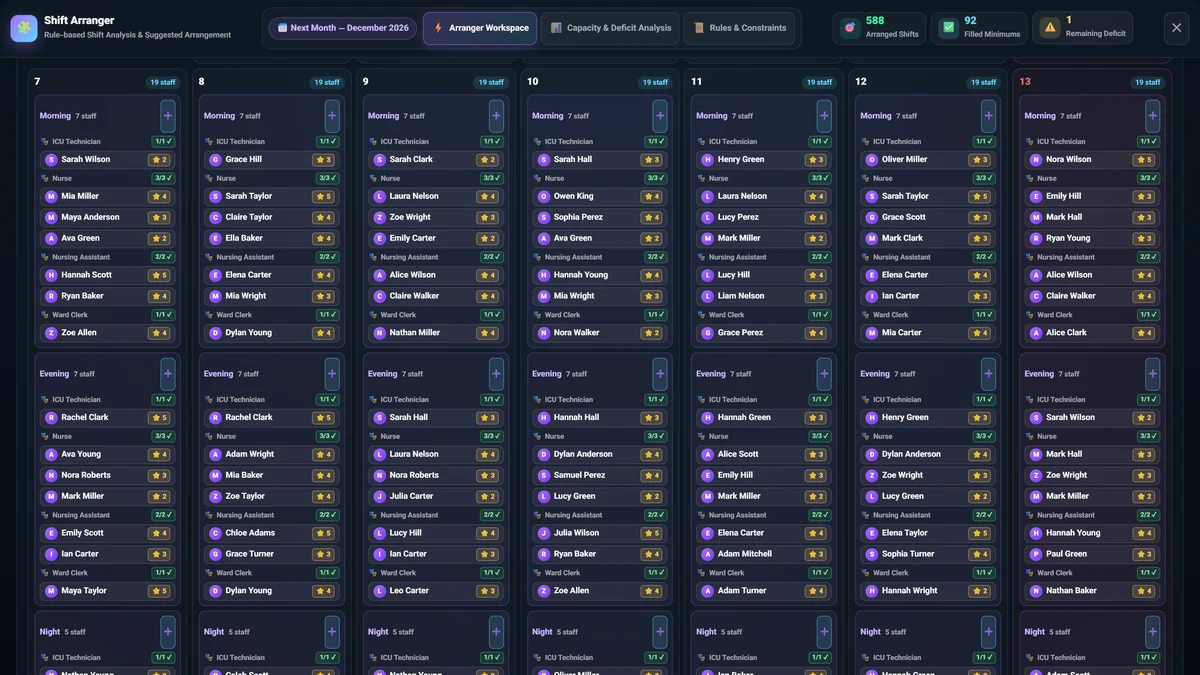
- Staff contribute with a proposed shift (priority 1 to 3) or a preferred shift from allowed options.
- Conflicts, hour caps and sequences are checked before publishing, not after complaints.
- Leave and swaps are handled inside the same roster, and eligible staff are suggested for cover.
How do I build the nurse roster fast?
Nurse burnout rarely comes from bedside care alone; it compounds when staff cannot predict next week's schedule or get booked into morning shifts right after exhausting nights. Here is how rule-driven scheduling protects recovery windows and keeps workload transparent.
The central question for head nurses is this: how do I build the nurse roster fast without losing ward coverage? The short answer is that speed comes from orderly inputs, not from hurried placement. When requests are scattered across messengers, every small correction moves a chain of table cells and the head nurse must review the whole grid several times. Experience in busy wards shows that most time goes to collecting and verifying requests, not to the final placement itself. So if the path for collecting, recording and reviewing requests becomes structured, preparation time falls noticeably and the manager energy stays free for supervision and decisions.
How do I build a conflict-free nurse roster?
Conflict means more than two shifts overlapping for one person; any state that breaks ward rules is a conflict: a shift without a qualified role, hours beyond the cap, a forbidden pair of back-to-back shifts, or a choice on a shift whose capacity is already full. In manual tables these cases usually appear after the roster is published and complaints begin. In a structured method, rules are written before rostering and checked during rostering; conflict is caught at the prevention stage, not at the compensation stage. This shift in detection time is the main difference between the two methods.
The most common conflict is hidden overlap: a nurse recorded in two separate lists, for example the main ward list and the on-call list, for the same period with neither list aware of the other. The next case is a role gap; the shift looks full by headcount but lacks the required qualified role such as the senior night nurse. The third case is silent cap breach: someone gradually passes the monthly cap through scattered overtime with no single summary warning. And the fourth case is requesting a shift whose capacity is practically full, which in manual work is usually solved by erasing one name and writing another; a fix that seeds the next complaint.
- One person overlapping in two parallel rosters without mutual notice.
- A shift full by headcount but missing the required specialist role.
- Gradual breach of hour caps with no warning summary.
- Requests placed on shifts whose capacity is already complete.
| Exhausting Manual Pattern | Real Impact on Nurses & Patient Care | Ergonomic Guardrail in Structured Rostering |
|---|---|---|
| Night-to-Morning Quick Returns | Acute sleep debt and higher medication-error risk | Hard 12-hour minimum rest rule between shifts |
| Uneven Night & Holiday Pile-Up | Perceived unfairness, resentment, and staff turnover | Monthly night cap and transparent rotation tracking |
| Last-Minute Roster Publication | Impossible family planning and chronic anxiety | Predictable request window and fast draft generation |
| Phone-Tag Shift Swapping | Constant interruptions for both nurses and head nurses | Rule-checked replacement list inside the workspace |

How do I include nurse constraints in shifts?
Every nurse carries real limits beyond the organizational role: impossible days, family preferences, medical limits, overtime ceilings and priority requests. In traditional work these limits live in the head nurse mind and among messages, and every new head nurse needs months to learn them. The fix is turning oral limits into written rules: every limit is recorded once and applied in every monthly rostering. This lowers manager mental load, removes ward dependence on one person memory and assures staff that their limits were seen.
Record limits in five groups so nothing drops: role limits showing who may take which shift, capacity limits with minimum and maximum per shift by role and gender, time limits with daily, weekly and monthly caps, personal limits with firm leave, medical limits and impossible days, and preferences with priority 1 to 3 per person per shift. The first three groups are ward rules set by the manager; the last two are staff inputs gathered in the request window. When these five groups are complete, the system knows who, in which ward, with which role, at which time, under which conditions and in which capacity may stand on a shift.
- Role limits: everyone stands only on shifts allowed for their approved role.
- Capacity limits: every shift owns a clear minimum and maximum by role and gender.
- Time limits: daily, weekly and monthly caps are respected per person.
- Personal limits: leave and impossible days are recorded before rostering.
How do I keep nurse rostering fair?
Fairness in rostering is the most sensitive and misunderstanding-prone ward topic. The subtle point is that the system never judges whether a manager is fair or not; such language is both wrong and offensive. The right framing is this: the system lets managers review and calculate shift distribution so they can observe the roster state more precisely. The tool gives transparent numbers and final judgment and decision stay with the manager. This boundary both preserves manager credibility and builds staff trust.
Fairness tools have three parts: distribution calculation from shifts and recorded staff priorities, transparent reports with night, evening, holiday and total hours per person, and corrective manager decisions with re-rostering or rule tuning. When reports show a colleague held the most nights three months in a row, the manager can consciously compensate; and when reports show balanced distribution, the same report shields the manager against complaints. Signing the final list in the inbox means the manager formally accepted responsibility for this distribution; the shared reliance point for all.
| Mid-Month Change Scenario | What Happens via Phone & Paper | Structured Leave & Replacement Flow |
|---|---|---|
| Sudden sick call before a shift | Frantic phone calls to every off-duty nurse | Instant list of eligible staff matching role, rest, and hour caps |
| Planned leave for next month | Paper slip forgotten while building the Excel sheet | Logged ahead of scheduling and respected automatically |
| Peer-to-peer shift swap | Informal trade that accidentally triggers a night-to-morning violation | Rule & cap validation on both colleagues before head-nurse approval |
| End-of-month reconciliation | Wall printout no longer matches actual shifts worked | Single live schedule with full change history |
To connect this workflow with adjacent tools and real examples, explore Live Shift Arranger Demo, Matron Oversight Guide, Clinical Productivity Law, Excel vs. Shift Software.
❓ Frequently Asked Questions from Real Workflows
Build next month structurally
Define the rules once and run the same logic every month; requests, leave and cover stay in one system.
Start free trialOr test a simulated ward right now without signing up in the Live Interactive Shift Arranger Demo.