
- Medical errors are the third leading preventable cause of death in healthcare worldwide, and over 40% of them stem from excessive clinician fatigue.
- Traditional scheduling cannot measure or control nurses' cognitive load and recovery time.
- AI guarantees patient safety and staff well-being by optimizing rest hours, fairly distributing specialties, and preventing consecutive night shifts.
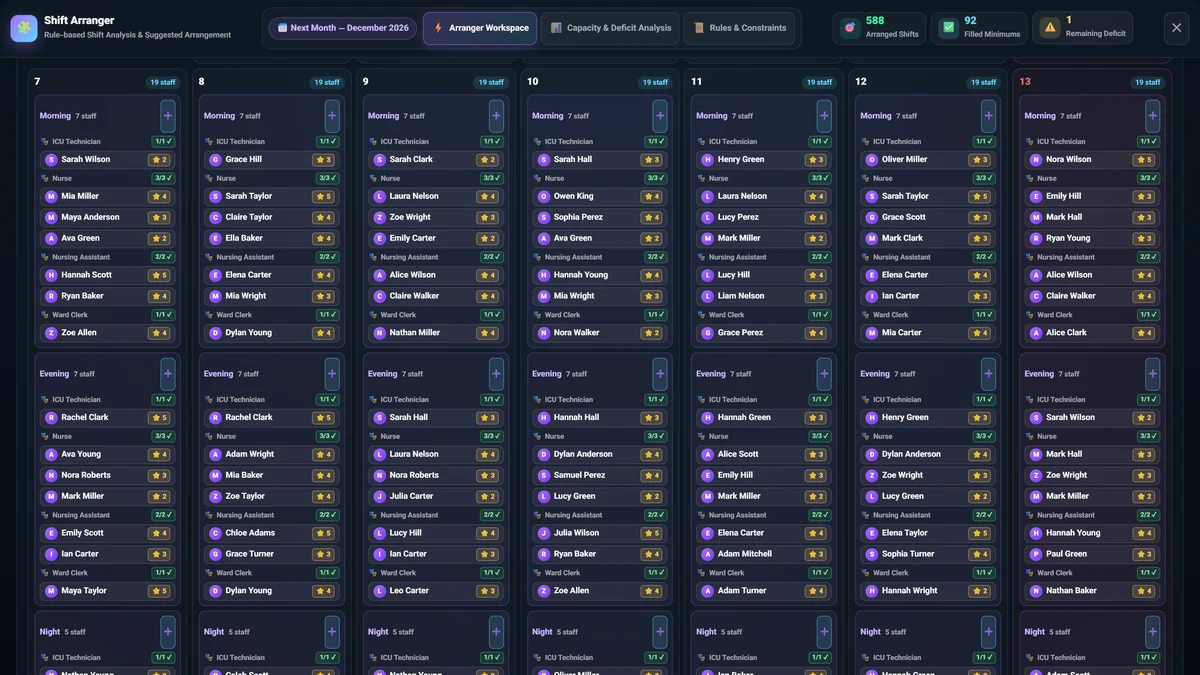
Shocking statistics: how clinician fatigue directly drives medical errors
Nurse burnout rarely comes from bedside care alone; it compounds when staff cannot predict next week's schedule or get booked into morning shifts right after exhausting nights. Here is how rule-driven scheduling protects recovery windows and keeps workload transparent.
In high-pressure hospital environments, human lives rest in the hands of nurses and physicians who make critical decisions in fractions of a second. According to World Health Organization (WHO) reports and papers published in reputable medical journals (such as The Lancet and BMJ), errors from wrong prescriptions, delayed injections and misread lab results increase up to 3-fold in the final hours of 12-hour shifts.
Circadian rhythm and why spreadsheets fail
The human body runs on a 24-hour biological rhythm. Between 3 and 6 a.m., alertness and brain reaction time hit their lowest point. With manual Excel planning, a ward manager has no tool to measure the cumulative effect of sleep deprivation (sleep debt).
Irregular shifts and so-called "reverse rotations" (such as an evening shift immediately after night duty) destroy the biological clock and cause a condition known as shift work sleep disorder (SWSD), whose certain consequence is reduced clinical safety.
| Buyer Criterion | Excel & Chat Apps | Generic Time-Clock Tools | Clinical Shift Platform (Axis Puls) |
|---|---|---|---|
| 12h Rest & No Night-to-Morning | Manual visual checks prone to fatigue | Logs punches only after violations happen | Preventive rule check before roster sign-off |
| 1.5x Night/Holiday Factor & Hour Caps | Fragile hand-written formulas | Lacks ward-specific clinical rules | Configurable per ward, role, and seniority |
| Staff Shift Preferences | Scattered across paper notes and DMs | Rigid or nonexistent | Priority 1–3 requests inside one calendar |
| Pre-Purchase Validation | No automated constraint check | Requires server setup & sales call | Instant live Shift Arranger demo + 2-month pilot |

Skill-matrix balance in every clinical ward
One of the most catastrophic outcomes of traditional planning is several junior nurses ending up together on a busy shift with no senior supervisor present. In critical situations (such as cardiac arrest or severe trauma), the absence of experienced staff sharply raises the risk of patient death.
AI at Axis Puls analyzes each ward's skill mix and guarantees that in every rota:
- At least one nurse skilled in advanced resuscitation (ACLS/CPR) is present.
- Experienced and novice staff numbers are in perfect balance.
- Skill coverage matches the ward's bed-occupancy rate.
- At least one nurse skilled in advanced resuscitation (ACLS/CPR) is present.
- Experienced and novice staff numbers are in perfect balance.
- Skill coverage matches the ward's bed-occupancy rate.
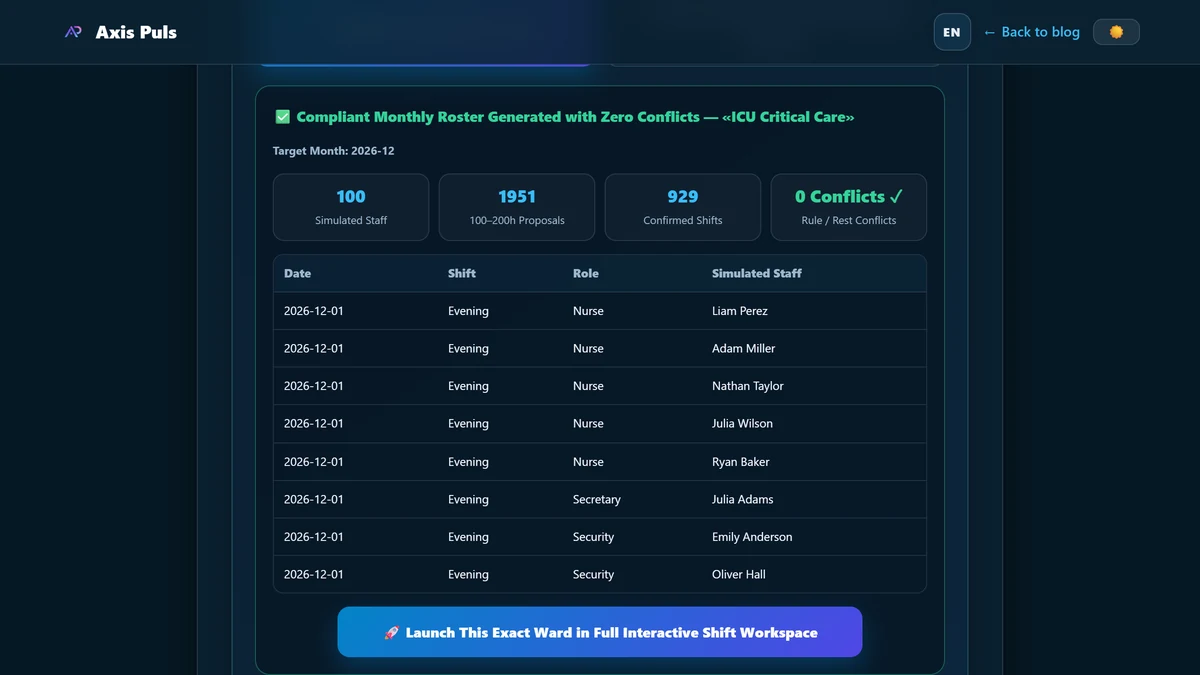
Roadmap for deploying smart scheduling in your hospital
The biggest mistake managers make is buying software before preparing the process. Experience from successful deployments shows that hospitals following these four steps reach a stable roster in under two months, while those jumping straight to "install and go" spend months fighting user resistance.
Every ward has unwritten rules: who wants Thursdays off, who must never do back-to-back nights, minimum senior cover per evening. Today these live in the head nurse's head. Week one of deployment must be spent extracting and registering them in the system; an algorithm is only as smart as its input.
| Hospital Role | Core Monthly Priority | Manual Bottleneck Today | Practical Outcome in Axis Puls |
|---|---|---|---|
| Shift Nurse / Staff | Predictable schedule and fair night rotation | Sending WhatsApp notes with no confirmation trail | Submit ranked preferences and track approval status |
| Head Nurse (Ward Lead) | Safe coverage across every shift without conflicts | Days spent rebuilding spreadsheets after one leave | Define ward rules once, generate drafts fast, sign off |
| Matron (Nursing Director) | Cross-ward balance and overtime visibility | Chasing mismatched Excel sheets across 10+ wards | Unified multi-ward oversight and clean sign-off trail |
| Hospital / HR Director | Compliance, cost control, and staff retention | Late attendance reconciliations and payroll disputes | Role-based access, audit logs, and verified monthly rosters |
When a nurse shows up for a morning shift after 16 hours of intense work or an exhausting night shift without enough rest, their brain performs like that of someone with a high blood-alcohol level. This is where the importance of scientific, error-free scheduling becomes clear.
Advanced algorithms in systems like Axis Puls smart shift management process numerous variables to build an ideal rota:
The system never allows dangerous consecutive shifts. For example, after a night shift ends, it automatically reserves at least 24 hours of recovery and will not assign a new shift.
AI evaluates each person's monthly history and distributes night shifts and intensive shifts completely equally and fairly across the whole team.
Imagine that at 10 p.m., an intensive-care nurse suddenly cannot attend their shift due to illness. Traditionally, the head nurse must make dozens of phone calls to find someone — who may well have worked that very morning!
On the smart platform, instead, the system suggests a list of eligible staff with one click (those who have rested enough, have not filled their duty-hour caps, and hold ICU skills) and confirms a replacement within minutes via app notifications and SMS.
A medical error is not only a clinical issue; it is a silent financial crisis. Health-economics research (Journal of Health Care Finance, 2023) estimates that each preventable harm event costs a hospital between $8,000 and $13,000 directly — longer stays, follow-up treatment and legal follow-up — before counting fines and reputational damage. For a 300-bed hospital, that runs into millions per year.
Two costs are painfully tangible everywhere: emergency overtime from last-minute absences and reshuffles, and losing experienced nurses, replacing whom costs months of time and training. A 2024 study of teaching hospitals in Tehran found wards with transparent, predictable rosters had roughly one-third the nurse turnover of wards with manual, late-announced schedules.
To connect this workflow with adjacent tools and real examples, explore Live Shift Arranger Demo, Nurse Shift Guide, Matron Oversight Guide.
❓ Frequently Asked Questions from Real Workflows
Upgrade your ward's safety with AI
Register with Axis Puls today and experience smart, fatigue-free scheduling aligned with international health standards.
Log in and try Axis Puls freeOr test a simulated ward right now without signing up in the Live Interactive Shift Arranger Demo.
Disclaimer: this article is educational content on hospital management and is not a substitute for specialist clinical or legal advice.
Sources
- World Health Organization — Patient safety programme: who.int/health-topics/patient-safety