
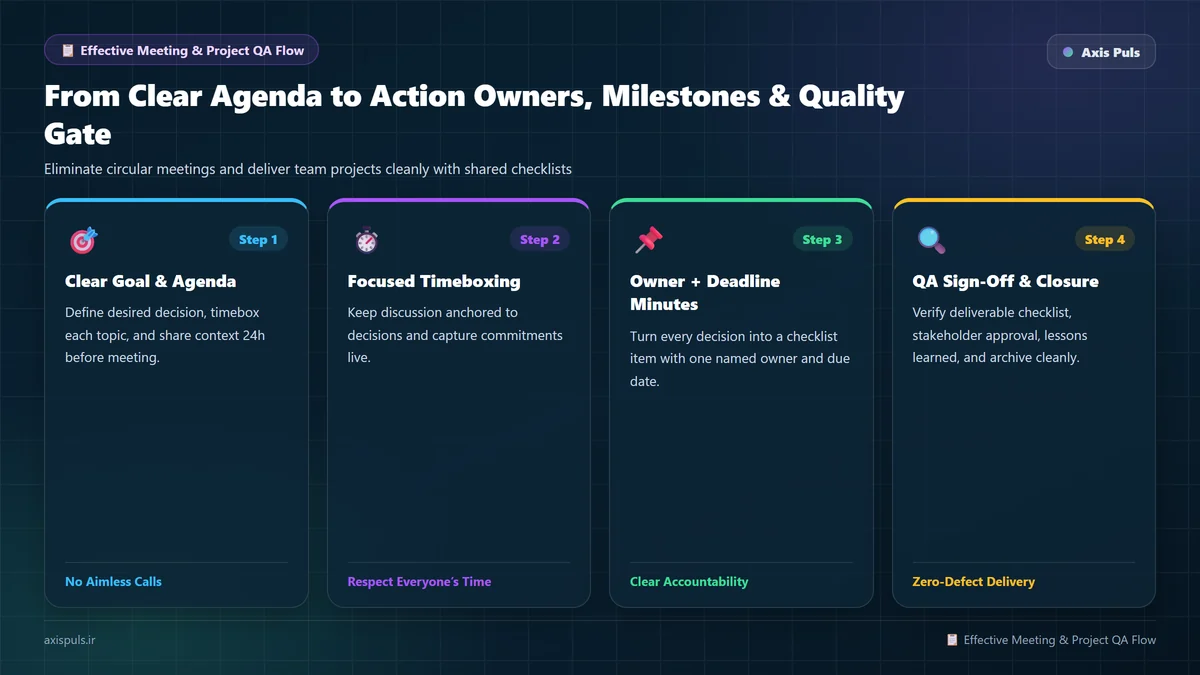
- An orderly meeting has three stages: before with a clear agenda, during with time control and after with follow-up.
- Send the agenda at least a day earlier and write time, presenter and expected output for each item.
- Record minutes during discussion and turn each decision into an action with owner and due date.
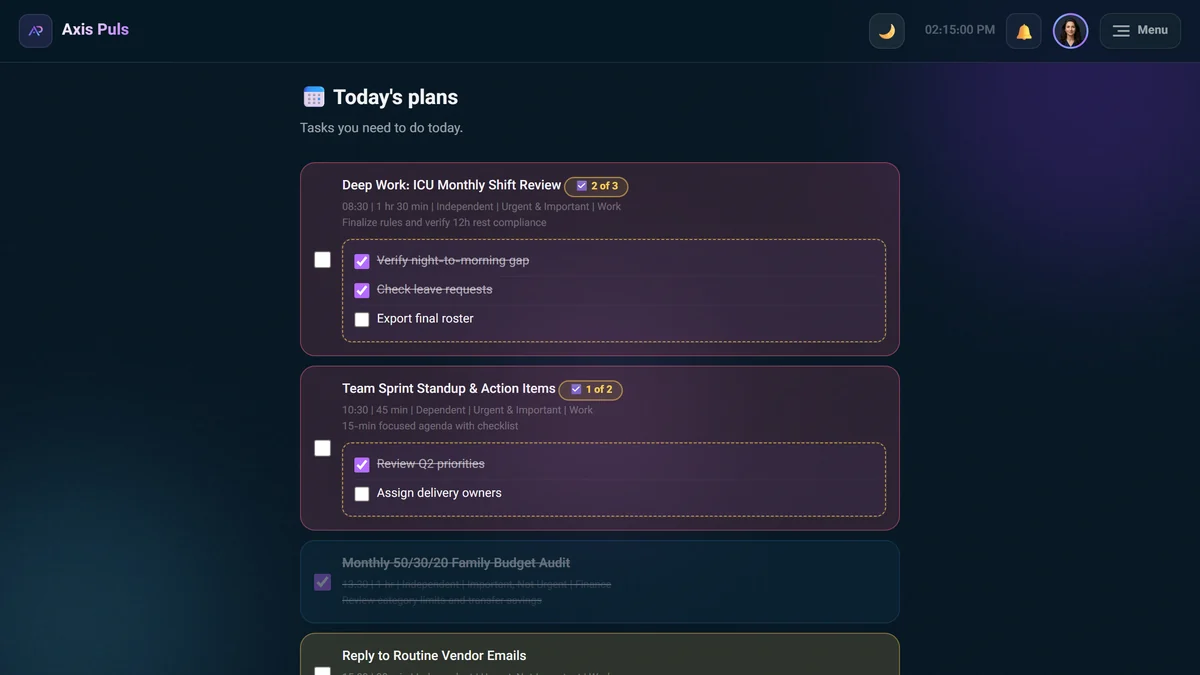
- Save the 22 steps below in Axis Puls so they carry date and reminder.
Why meetings stall without a checklist?
Forgetting a passport, charger, or key project deliverable rarely happens because you don't care—it happens because working memory drops obvious details under time pressure. This 5-minute guide organizes your checklist into calm, timed waves so nothing slips through.
Forgetting a passport, charger, or key project deliverable rarely happens because you don't care—it happens because working memory drops obvious details under time pressure. This 5-minute guide organizes your checklist into calm, timed waves so nothing slips through.
How to write a clear agenda?
A clear agenda is the contract before starting and it shapes discussion quality. It answers four questions: why we meet, which items we discuss, how much time each item has and what output each item expects. With those four written, attendees arrive prepared, discussion stays on track and success can be judged. A vague agenda does the opposite; it gathers everyone without a success criterion.
Write each item with verb and output rather than a general topic. Instead of “sales review”, write “decide autumn discount in 15 minutes with Sara presenting the report, output: choose one of two scenarios”. That sentence carries time, presenter and output. When five items share this precision, total time becomes visible and overruns can be trimmed early.
| Group Coordination Dimension | Scattered Messenger Group Chats | Structured Group Plan in Axis Puls |
|---|---|---|
| Headcount Confirmation | Vague 'maybe' replies buried under 200 off-topic messages | Clear invite flow with explicit Accept / Decline status |
| Shared Gear & Task Split | Two people buy charcoal while nobody brings the first-aid kit | One shared checklist attached directly to the event |
| Time or Venue Updates | Latecomers miss changes scrolled out of view | Single source of truth for date, time, and plan notes |
| Splitting Shared Costs | Awkward spreadsheet math days after the trip ends | Built-in group expense tracking and simplified settlement |
How to record accurate minutes?
Minutes are the formal memory of the meeting and should be written during or right after it; longer gaps lose detail. Good minutes are short but complete: instead of long discussion retelling, they record decisions and actions precisely. For each decision write four fields: what was decided, what action follows, who owns it and what the due date is. If acceptance criteria are clear, add them to prevent next-week disputes.
Use verb-centered sentences with owner and date. Instead of “discount will be followed”, write “Sara sends the two-scenario comparison by Tuesday 16:00 and the final decision is recorded Wednesday”. Such sentences need no guessing. Avoid recording conflicting opinions; record only the final decision and next action with one context line when needed.
Instead of designing an elaborate system you abandon by Thursday, spend just three minutes each evening closing open loops and picking tomorrow's top three items inside your personal planner. Small, steady habits beat occasional perfection every time.
How to save it in Axis Puls?
In Axis Puls the checklist lives inside the meeting plan rather than apart. Open add plan, write the meeting title with date and hour, then enter these 22 steps as the inner checklist; each step becomes a separate row ticked during execution. Because the list travels with the plan, the plan reminder covers all steps and brings agenda forward on time. Sign-in uses an SMS code with no password to remember.
For group meetings build a group plan and invite members so agenda and minutes stay visible to all. Each action can be a separate plan with owner and date so it appears in each Today and in the timeline weekly view. Build from add plan, and for background see the complete checklist guide and the meeting planning wiki. Try one meeting with these 22 steps this week and compare recording and follow-up.
| Preparation Wave | Critical Items & Actions | Common User Mistake | Practical Fix Inside Your Plan |
|---|---|---|---|
| Wave 1: 3–7 Days Ahead | IDs/documents, bookings, essential meds, budget, role split | Packing clothes first and leaving documents to the night before | Pin non-negotiable items at the top of the plan checklist |
| Wave 2: Night Before | Main bag/gear setup, charging devices, home/venue prep | Relying on tired late-night memory | Tick items off one by one as they enter the bag |
| Wave 3: Final 30 Minutes | Keys, phone, bank cards, charger in wall socket, meeting deck | Leaving everyday essentials plugged into the wall | Run a 2-minute doorway scan before stepping out |
| Post-Event Wrap-Up | Settle shared expenses and note missing items for next time | Rebuilding the same list from scratch next month | Reuse your saved plan checklist as a proven template |
Many meetings stall because of missing structure rather than missing knowledge. The agenda arrives late or not at all, attendees do not know their roles, discussion drifts, time goes to low-value items and at the end nobody knows what was decided and who does what by when. After a few repeats, people start seeing meetings as lost time. A meeting checklist moves the team from memory and guesswork toward written and trackable work.
Instead of designing an elaborate system you abandon by Thursday, spend just three minutes each evening closing open loops and picking tomorrow's top three items inside your personal planner. Small, steady habits beat occasional perfection every time.
Busy-team experience points to three common roots: vague agenda, incomplete records, or dropped follow-up. A vague agenda lists topics without time or output, so everyone brings a different expectation. Incomplete records mean a good discussion ends in a general sentence that nobody can act on next week. Dropped follow-up means decisions never become owned actions with dates and disappear in daily noise. All three can be controlled with a simple list and steady execution. For calendar basics see the meeting planning guide.
To connect this workflow with adjacent tools and real examples, explore Personal Planner, Eisenhower Matrix, Time-Blocking Guide, Weekly Planning, Smart Checklists, Group Planning.
❓ Frequently Asked Questions from Real Workflows
Turn these 22 steps into a live list
Save the checklist in Axis Puls; with date, reminder and progress bar, no decision stays unseen.
Save meeting checklist