
- To-do says “what”, time-blocking says “when”. Every key task gets a calendar block with start and duration; the rest of the day arranges around it.
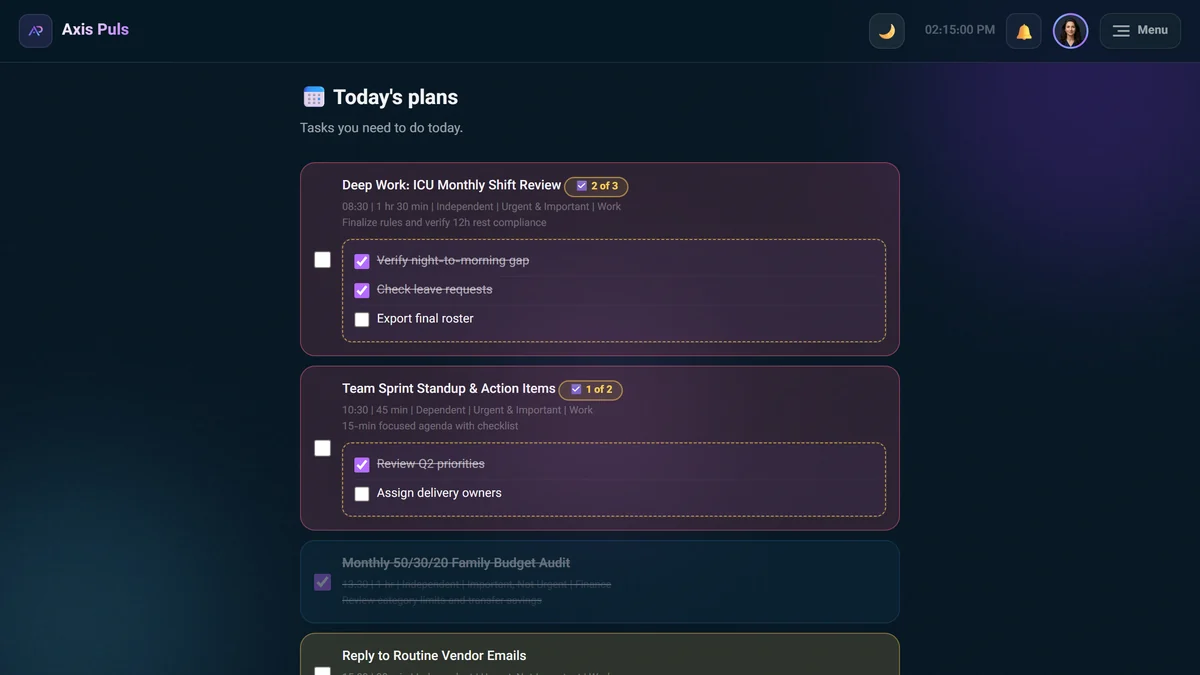
- In Axis Puls give each plan a start time and duration; overlapping blocks trigger an instant conflict warning.
- 50-minute focus blocks + 10-minute breaks double deep output.
- Keep one meeting-free day weekly; the deepest work lives there.
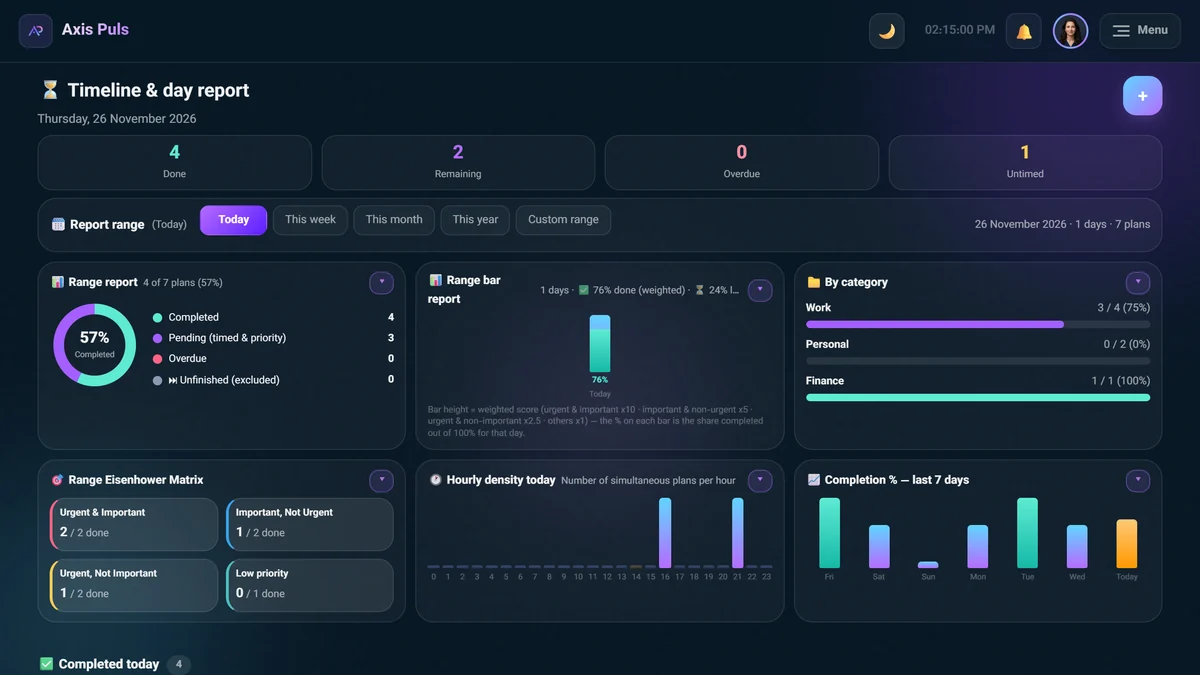
Interactive Time Blocking Builder (50–90 Min Focus Blocks)
Budget your day into focused 50–90 minute time blocks with breathing buffers, spot overlaps instantly on the 24h bar, and save.
Live preview of your schedule
Why lists aren’t enough
Most daily plans fall apart not from lack of discipline, but from overloading a flat list with twenty competing tasks before 9 a.m. In this practical 5-minute guide, we strip away productivity fluff and build a realistic rhythm using clear priorities and visual time blocks.
Most daily plans fall apart not from lack of discipline, but from overloading a flat list with twenty competing tasks before 9 a.m. In this practical 5-minute guide, we strip away productivity fluff and build a realistic rhythm using clear priorities and visual time blocks.
Your first time block
In “Add plan”: title, start time (e.g. 09:00) and duration (e.g. 50 minutes). It lands on the day timeline with a reminder. Start tomorrow, not today; three blocks suffice.
| Daily Planning Method | Real Practical Strength | Hidden Pitfall | Best Everyday Use Case |
|---|---|---|---|
| Plain Paper To-Do List | Zero friction and satisfying checkmarks | No time slots; urgent trivia crowds out deep work | Top 3 desk priorities for the morning |
| Calendar Slots Only | Clear view of fixed appointments | Treats low-impact errands the same as critical goals | Meetings, classes, and work shifts |
| Timeline + Eisenhower Priority (Axis Puls) | Combines time order in Today view with clear urgency/importance | Takes 30 seconds to tag priority when adding a plan | Busy workdays and rotating shift schedules |
| Weekly Review + Buffer Blocks | Absorbs unexpected delays without derailing the week | Requires a 15-minute weekly reset habit | Balancing career, study, and family life |
Four rules of lasting blocks
Instead of designing an elaborate system you abandon by Thursday, spend just three minutes each evening closing open loops and picking tomorrow's top three items inside your personal planner. Small, steady habits beat occasional perfection every time.
- One block, one task: no multitasking inside.
- Buffer: 10–15 minutes between blocks.
- Breaks are blocks too: log lunch and rest.
- Review nightly: move undone blocks consciously.
- One block, one task: no multitasking inside.
- Buffer: 10–15 minutes between blocks.
- Breaks are blocks too: log lunch and rest.
- Review nightly: move undone blocks consciously.
Energy management vs. time management: the new productivity paradigm
For decades we were told to “manage time”; but the real shortage was never time — it is focused energy. We all get the same 24 hours, yet two morning hours of one person differ wildly in cognitive quality from two evening hours of the same person. Tony Schwartz's well-known work showed top performers manage energy, not calendars: enough sleep, decent food, strategic breaks, alternating strain and recovery.
Applied to blocking: schedule by available energy, not just free hours. Creative and decision-heavy work only at peaks; routine admin in valleys. And most importantly: recovery gets blocks too. Real rest (not Instagram scrolling!) — walks, water, gazing far away, a few deep breaths — belongs in the calendar and counts as seriously as meetings. Sustainable productivity is a marathon with water stations, not an endless sprint.
| Preparation Wave | Critical Items & Actions | Common User Mistake | Practical Fix Inside Your Plan |
|---|---|---|---|
| Wave 1: 3–7 Days Ahead | IDs/documents, bookings, essential meds, budget, role split | Packing clothes first and leaving documents to the night before | Pin non-negotiable items at the top of the plan checklist |
| Wave 2: Night Before | Main bag/gear setup, charging devices, home/venue prep | Relying on tired late-night memory | Tick items off one by one as they enter the bag |
| Wave 3: Final 30 Minutes | Keys, phone, bank cards, charger in wall socket, meeting deck | Leaving everyday essentials plugged into the wall | Run a 2-minute doorway scan before stepping out |
| Post-Event Wrap-Up | Settle shared expenses and note missing items for next time | Rebuilding the same list from scratch next month | Reuse your saved plan checklist as a proven template |
A 12-item list at 9 PM is still 12 items because none had a slot. The brain gives zero priority to unscheduled work. Time-blocking turns each task into an appointment with yourself.
Suggested rhythm: 50 minutes deep work (silent phone, closed tabs) + 10 real rest. After 3 cycles, a long break. Pair with Eisenhower priority: mornings belong to important-non-urgent blocks.
New blocks overlapping meetings trigger an instant conflict warning. No more double-booked shame.
Declare one weekday a no-meeting zone with 3 back-to-back focus blocks. One such day rivals a scattered week. The empty timeline shouts it.
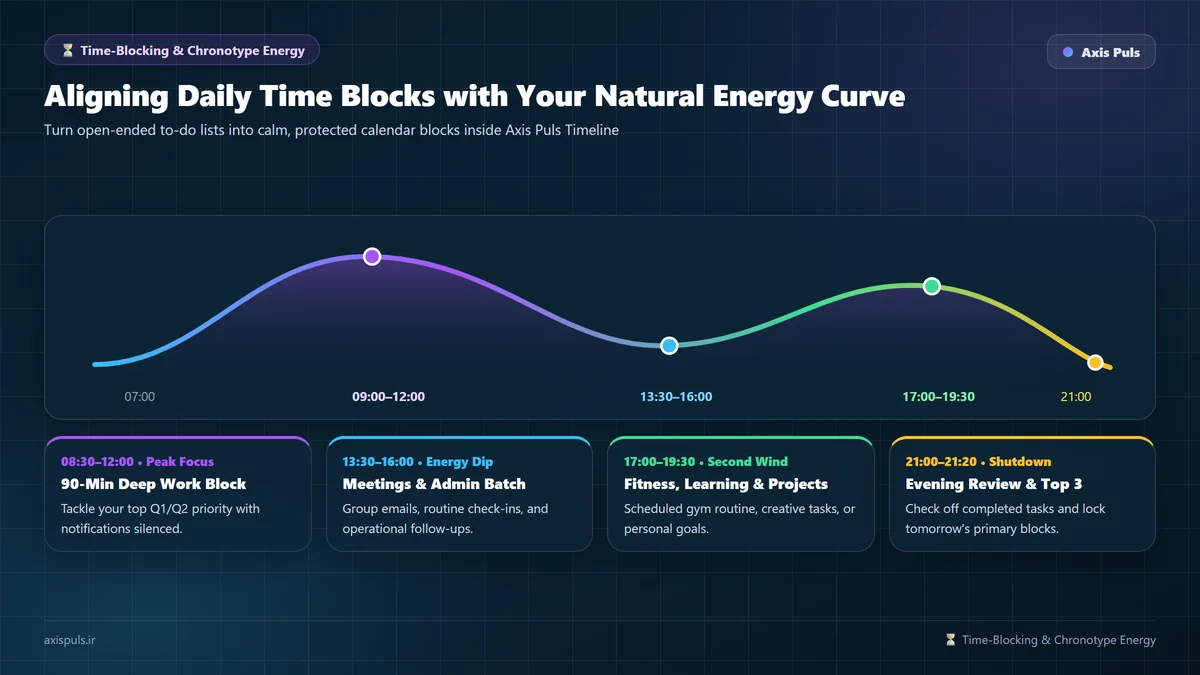
Not all brains are morning brains. Chronobiology research shows roughly 15% of people are “wolves” (night owls), 15% “lions” (early birds), the rest somewhere between. The common mistake is scheduling the hardest work at 8 a.m. for everyone; for a true wolf, peak focus hits at 10 p.m. and a morning deep block is wasted. Track yourself for one week: when is your mind sharp, when foggy? Then place deep blocks on your peaks and admin work in your valleys.
Know your three daily energy zones: the first peak (2–3 hours after fully waking) for the hardest task, the midday dip (after lunch) for light work and meetings, and a short second peak (late afternoon) for reviews and next-day planning. A schedule fighting your biology never runs, however beautiful.
To connect this workflow with adjacent tools and real examples, explore Personal Planner, Eisenhower Matrix, Weekly Planning, Smart Checklists, Group Planning, Personal Finance Tracker.