
- A week without a plan plans you. A 20-minute Sunday review changes the next 7 days.
- In Axis Puls lay out the week with categories (work, personal, health) and Eisenhower priority; each day gets 3 key tasks.
- The week timeline reveals overloaded days so you declutter Tuesday in advance.
- Rule 1-3-5: daily 1 big, 3 medium, 5 small — more breaks the list, not builds you.
Online Weekly Planning & Review Schedule Builder
Pick any day of the week from the calendar, schedule your kickoff, core midweek blocks, catch-up buffer, and weekly review.
Live preview of your schedule
Why day-view fails
Most daily plans fall apart not from lack of discipline, but from overloading a flat list with twenty competing tasks before 9 a.m. In this practical 5-minute guide, we strip away productivity fluff and build a realistic rhythm using clear priorities and visual time blocks.
Most daily plans fall apart not from lack of discipline, but from overloading a flat list with twenty competing tasks before 9 a.m. In this practical 5-minute guide, we strip away productivity fluff and build a realistic rhythm using clear priorities and visual time blocks.
The 20-minute weekend review
Friday or Sunday night, 20 minutes:
- Review last week: done, missed, why (no blame).
- Seat fixed appointments first (classes, meetings, bills).
- Pick max 3 key tasks per day; the rest queues.
| Daily Planning Method | Real Practical Strength | Hidden Pitfall | Best Everyday Use Case |
|---|---|---|---|
| Plain Paper To-Do List | Zero friction and satisfying checkmarks | No time slots; urgent trivia crowds out deep work | Top 3 desk priorities for the morning |
| Calendar Slots Only | Clear view of fixed appointments | Treats low-impact errands the same as critical goals | Meetings, classes, and work shifts |
| Timeline + Eisenhower Priority (Axis Puls) | Combines time order in Today view with clear urgency/importance | Takes 30 seconds to tag priority when adding a plan | Busy workdays and rotating shift schedules |
| Weekly Review + Buffer Blocks | Absorbs unexpected delays without derailing the week | Requires a 15-minute weekly reset habit | Balancing career, study, and family life |
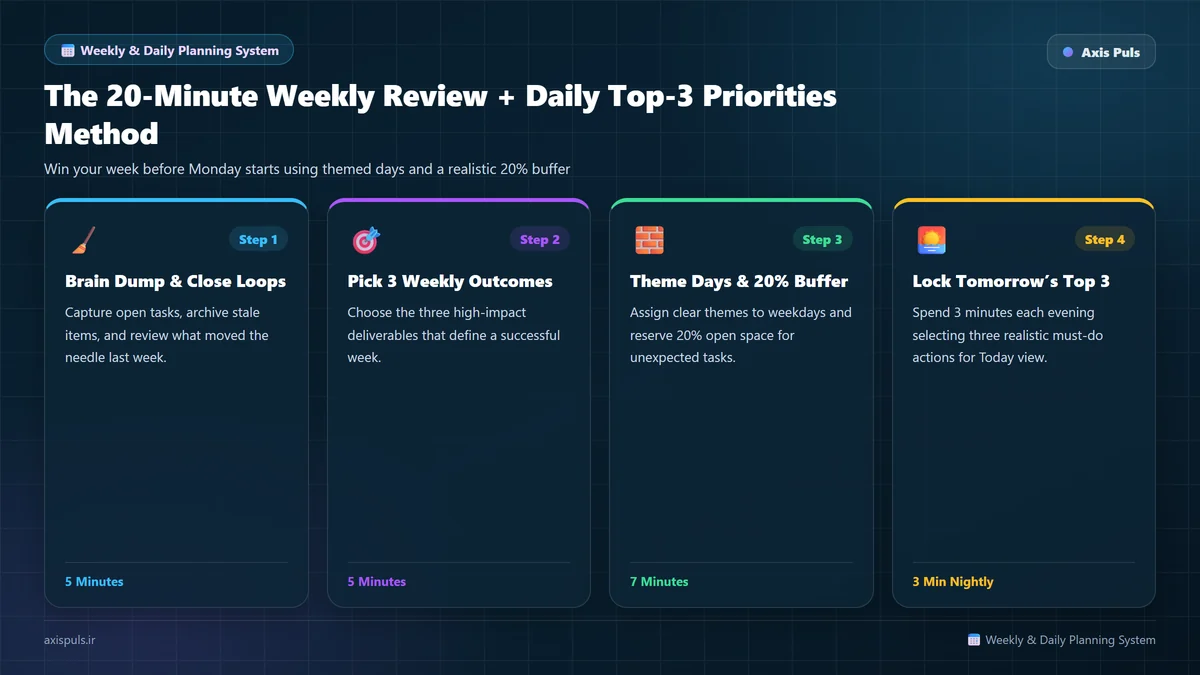
Three rules of a sustainable week
Instead of designing an elaborate system you abandon by Thursday, spend just three minutes each evening closing open loops and picking tomorrow's top three items inside your personal planner. Small, steady habits beat occasional perfection every time.
- Rule 1-3-5: daily 1 big, 3 medium, 5 small.
- Keep one buffer day (usually Friday) for spillover.
- A week at 80% done is a win; perfectionism kills consistency.
Instead of designing an elaborate system you abandon by Thursday, spend just three minutes each evening closing open loops and picking tomorrow's top three items inside your personal planner. Small, steady habits beat occasional perfection every time.
- Review last week: done, missed, why (no blame).
- Seat fixed appointments first (classes, meetings, bills).
- Pick max 3 key tasks per day; the rest queues.
- Rule 1-3-5: daily 1 big, 3 medium, 5 small.
- Keep one buffer day (usually Friday) for spillover.
- A week at 80% done is a win; perfectionism kills consistency.

Syncing workweek and personal life: ending the two-front war
Productivity's biggest lie is that “work-life balance” means 50-50. Reality: in project weeks work is 80%, in family weeks life is. True balance lives in the seasonal average, not each week. Instead of weekly guilt, check the scale each season: which way did this season tilt? Compensate next season. That lens cuts stress and smartens decisions alike.
The practical tool is a “time budget” like a money budget: 168 hours a week; sleep (56), work (45), family (20), self (10), rest (37) — write these honestly once and see where you stand. Most people are shocked: “where does all my time go?” The answer usually hides in the leftover 37: aimless scrolling, pointless meetings, dawdling. Once budgeted transparently, fixing is easy. Do this exercise this very weekend; it takes 15 minutes but rewrites your year-long view of time. Many first-timers finally understand why they “have no time” despite 168 weekly hours.
| Preparation Wave | Critical Items & Actions | Common User Mistake | Practical Fix Inside Your Plan |
|---|---|---|---|
| Wave 1: 3–7 Days Ahead | IDs/documents, bookings, essential meds, budget, role split | Packing clothes first and leaving documents to the night before | Pin non-negotiable items at the top of the plan checklist |
| Wave 2: Night Before | Main bag/gear setup, charging devices, home/venue prep | Relying on tired late-night memory | Tick items off one by one as they enter the bag |
| Wave 3: Final 30 Minutes | Keys, phone, bank cards, charger in wall socket, meeting deck | Leaving everyday essentials plugged into the wall | Run a 2-minute doorway scan before stepping out |
| Post-Event Wrap-Up | Settle shared expenses and note missing items for next time | Rebuilding the same list from scratch next month | Reuse your saved plan checklist as a proven template |
Seeing only “today” means permanent firefighting; important-but-not-urgent things (exercise, learning, relationships) never get slots. The week is the only scale with both overview and executability.
Give every plan a category and an Eisenhower priority. The week should look balanced: if all 7 days are “work”, deliberately slot health in.
The timeline shows the week like an aerial map: find red overloaded days and move one task to a light day. The conflict check warns on new entries.
Once laid out, days run themselves: open the Today page each morning; the daily reminder previews tomorrow at night. If a day derails, reshuffle just that day.
One of the most powerful techniques product managers at large companies use is “themed days”: Mondays for planning and meetings, Tuesdays–Wednesdays for deep production work, Thursdays for meetings and follow-ups, Fridays for closing open loops and learning. When each day has a role, daily deciding disappears; you wake up knowing what “today is for”.
To connect this workflow with adjacent tools and real examples, explore Personal Planner, Eisenhower Matrix, Time-Blocking Guide, Smart Checklists, Group Planning, Personal Finance Tracker.