
- The daily schedule is Three things are clear.A few anchors and a priority list, not filling every minute with work.
- With The Matrix of Eisenhower. (Urgency) Know what you do, schedule, abandon or delete.
- I'm working an hour with The clock is set and the clock is a reminder. Register and keep the rest on the priority list.
- The routines. They automate repetitive tasks with a repetitive formula.
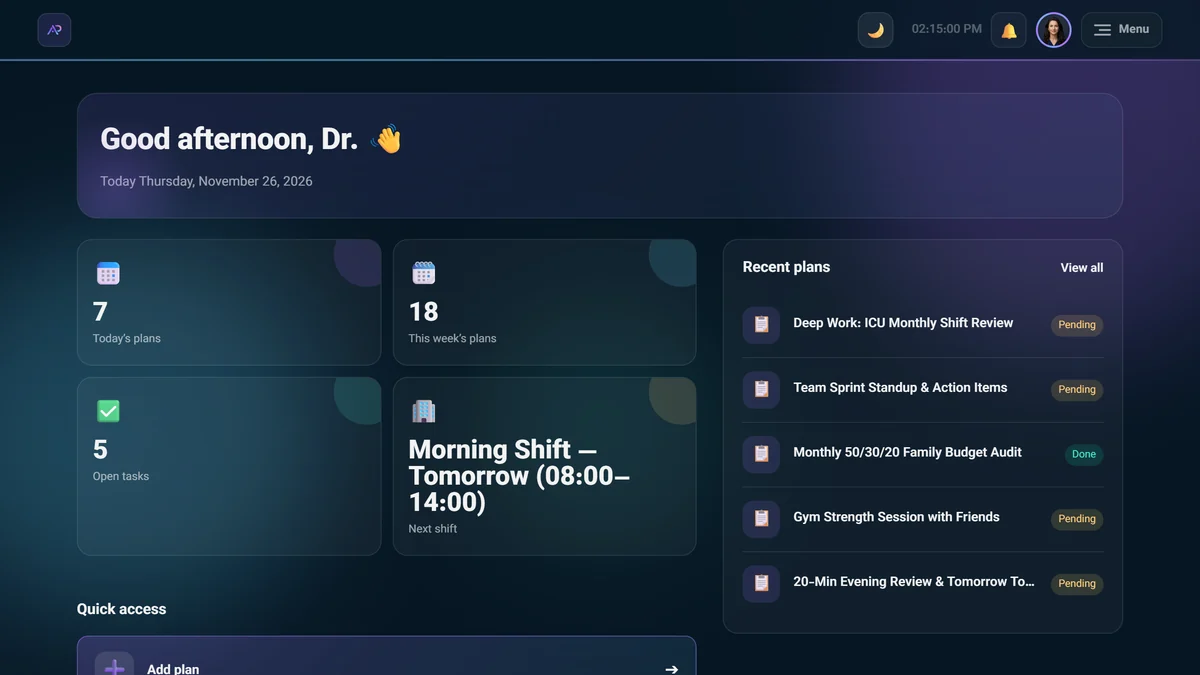
Online Personal Planning Builder (Daily & Weekly)
Turn your personal priorities into clear time blocks, check for conflicts on the 24h bar, export to calendar, or save straight to your account.
Live preview of your schedule
How can we have a daily schedule?
Most daily plans fall apart not from lack of discipline, but from overloading a flat list with twenty competing tasks before 9 a.m. In this practical 5-minute guide, we strip away productivity fluff and build a realistic rhythm using clear priorities and visual time blocks.
Most daily plans fall apart not from lack of discipline, but from overloading a flat list with twenty competing tasks before 9 a.m. In this practical 5-minute guide, we strip away productivity fluff and build a realistic rhythm using clear priorities and visual time blocks.
How do we manage our daily tasks?
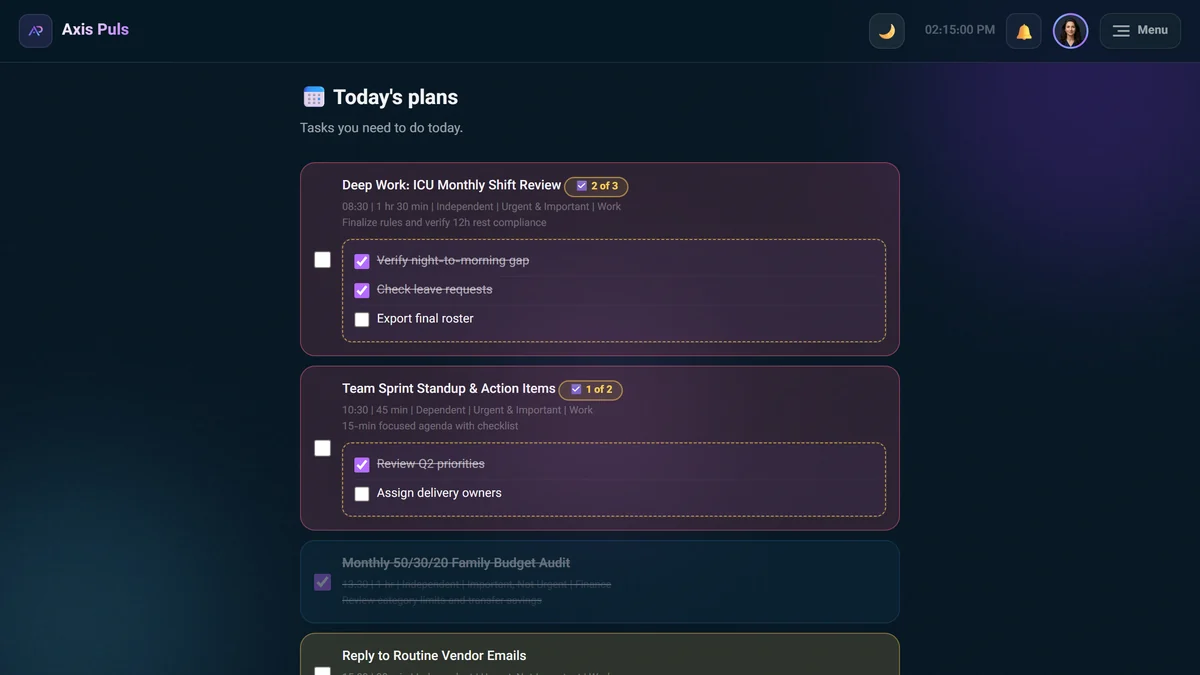
Day-to-day management is a set of habits that keep a schedule alive from morning to night and not get caught up in the pressure of messages and events. Many people write good plans but lose everything in the afternoon because they just plan for the day but don't have a management system. Day-to-day management has three main skills: instant recording of any new job, quick decision about where to do any job, and short review in the middle of the day.
The human brain is built to think, not to store; anything that is just remembered or forgotten or consumed with background anxiety. The law of instant recording says that any new thing that comes to your mind or is assigned to you will enter the system in less than two minutes. That is, open your phone and record it in the Axis Puls app add form immediately, even if it is incomplete and details will be completed later.
| Daily Planning Method | Real Practical Strength | Hidden Pitfall | Best Everyday Use Case |
|---|---|---|---|
| Plain Paper To-Do List | Zero friction and satisfying checkmarks | No time slots; urgent trivia crowds out deep work | Top 3 desk priorities for the morning |
| Calendar Slots Only | Clear view of fixed appointments | Treats low-impact errands the same as critical goals | Meetings, classes, and work shifts |
| Timeline + Eisenhower Priority (Axis Puls) | Combines time order in Today view with clear urgency/importance | Takes 30 seconds to tag priority when adding a plan | Busy workdays and rotating shift schedules |
| Weekly Review + Buffer Blocks | Absorbs unexpected delays without derailing the week | Requires a 15-minute weekly reset habit | Balancing career, study, and family life |
How can we not forget things?
Forgetting is usually not a memory problem, but a system problem; that is, work is either not recorded at all or somewhere recorded that is not seen in time. Most of us rely too much on our memory and blame ourselves after we leave an important meeting. But memory research shows that forgetting future tasks is completely normal and the solution is not memory enhancement but building a memory system.
The first and most important defense layer is that nothing is just left in your mind and everything is recorded immediately in the external system. The more you push it, the more forgetfulness and anxiety you have. The rule of thumb is: every task, appointment or idea that comes to your mind, enters Axis Puls in less than two minutes.
Instead of designing an elaborate system you abandon by Thursday, spend just three minutes each evening closing open loops and picking tomorrow's top three items inside your personal planner. Small, steady habits beat occasional perfection every time.
Practical conclusions and start of a stable system
In this column, we're taking the entire path of personal planning from asking how to schedule a day to managing repetitive tasks. Now you have all the pieces of the puzzle: three important tasks, the Eisenhower Matrix, the priority list, scheduling, meeting recall, routines, and repetition formula. This final section turns them into a 30-day starting plan to know exactly what to do tomorrow morning.
The first week, just make two habits: take ten minutes of your schedule each night and do three important first things each morning. These two habits have 80% of the overall system effect, and the rest are decoration. At the end of the first week, count the days you've had success; if it's been over five days, you're ready for the second week.
| Preparation Wave | Critical Items & Actions | Common User Mistake | Practical Fix Inside Your Plan |
|---|---|---|---|
| Wave 1: 3–7 Days Ahead | IDs/documents, bookings, essential meds, budget, role split | Packing clothes first and leaving documents to the night before | Pin non-negotiable items at the top of the plan checklist |
| Wave 2: Night Before | Main bag/gear setup, charging devices, home/venue prep | Relying on tired late-night memory | Tick items off one by one as they enter the bag |
| Wave 3: Final 30 Minutes | Keys, phone, bank cards, charger in wall socket, meeting deck | Leaving everyday essentials plugged into the wall | Run a 2-minute doorway scan before stepping out |
| Post-Event Wrap-Up | Settle shared expenses and note missing items for next time | Rebuilding the same list from scratch next month | Reuse your saved plan checklist as a proven template |
Having a daily schedule doesn't mean filling every minute with work, but it means knowing in advance which three things are really important today and the rest of the day is going around them. Those who enter the day without a schedule are usually taken captive by the first message, first call, or loudest noise, and go to bed at night tired but without a sense of progress.
Instead of designing an elaborate system you abandon by Thursday, spend just three minutes each evening closing open loops and picking tomorrow's top three items inside your personal planner. Small, steady habits beat occasional perfection every time.
To connect this workflow with adjacent tools and real examples, explore Personal Planner, Eisenhower Matrix, Time-Blocking Guide, Weekly Planning, Smart Checklists, Group Planning.
❓ Frequently Asked Questions from Real Workflows
Write down a schedule for tomorrow every night for 10 minutes: set three important tasks, set a timeline for timely tasks, and put the rest on your priority list. Just run in the morning and do a five-minute review in the afternoon. After three weeks, the cycle becomes a habit.
Transfer all tasks from your mind to your system immediately and decide in less than a minute whether to do, schedule or delete any new task today. Today's Axis Puls page shows three important tasks, the timeline and the list in one place.
First, break down three to five goals into weekly steps each month, and then every Thursday, break down the next week's portion into days. And every night, pull the schedule of tomorrow out of the heart of the week.
Take charge of your day starting tomorrow morning
Tonight, save tomorrow’s three most important tasks in Axis Puls and wake up with a plan. SMS login, no password, in under a minute.
Log in and start planningTo continue your learning path, return to Personal planning hub .