
- Habits come from systems, not willpower. A daily routine is a task with a fixed time that reminds you and ends with one tick.
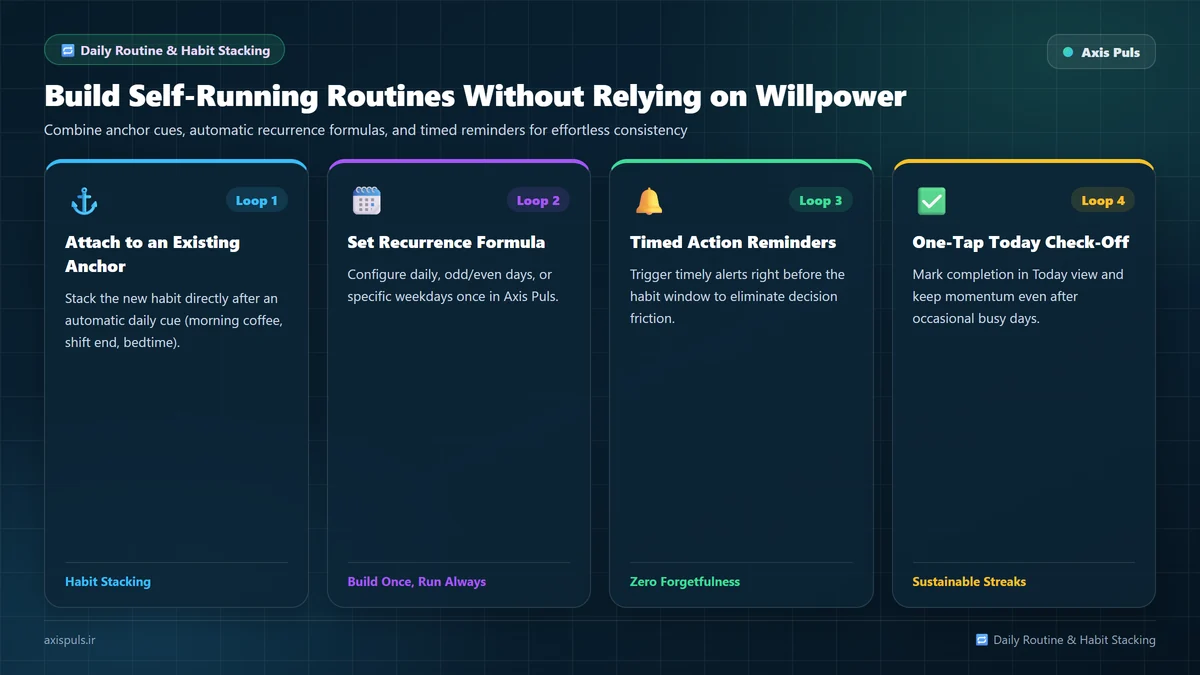
- In Axis Puls, recurrence formulas (daily, weekdays, month days, date ranges) automate any habit after one setup.
- Smart reminders ping on time and the Today page lists everything with ticks.
- Start tiny (10 minutes of reading); steady users keep 80%+ adherence.
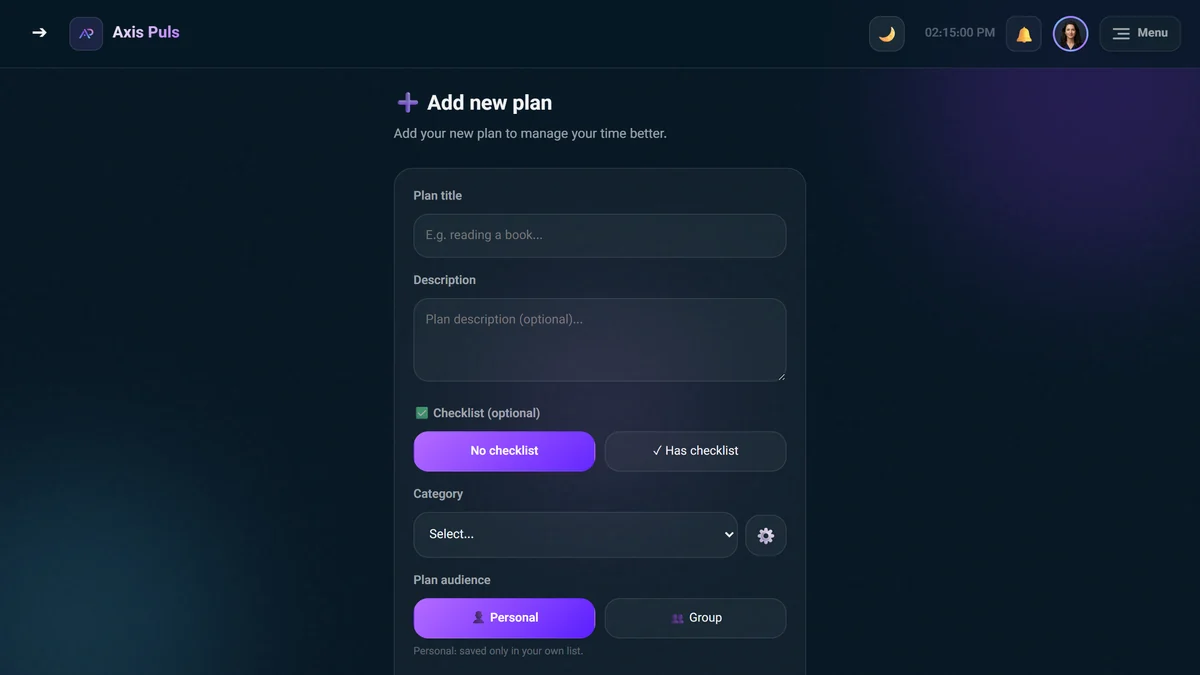
Interactive Habit Stacking & Daily Routine Builder
Anchor small repeatable habits to exact times of day, preview them on the 24h bar, and save as recurring routines with reminders.
Live preview of your schedule
Why willpower fails habits
Most daily plans fall apart not from lack of discipline, but from overloading a flat list with twenty competing tasks before 9 a.m. In this practical 5-minute guide, we strip away productivity fluff and build a realistic rhythm using clear priorities and visual time blocks.
Most daily plans fall apart not from lack of discipline, but from overloading a flat list with twenty competing tasks before 9 a.m. In this practical 5-minute guide, we strip away productivity fluff and build a realistic rhythm using clear priorities and visual time blocks.
Recurrence: build once, run forever
Pick a recurrence formula when creating a plan:
- Daily: exercise, reading, medication — same hour.
- Weekdays: specific days (e.g. Mon/Wed/Fri gym).
- Month days: 1st and 15th for bills and payroll.
- Date range: start to end (e.g. a 30-day challenge), auto window from today.
| Daily Planning Method | Real Practical Strength | Hidden Pitfall | Best Everyday Use Case |
|---|---|---|---|
| Plain Paper To-Do List | Zero friction and satisfying checkmarks | No time slots; urgent trivia crowds out deep work | Top 3 desk priorities for the morning |
| Calendar Slots Only | Clear view of fixed appointments | Treats low-impact errands the same as critical goals | Meetings, classes, and work shifts |
| Timeline + Eisenhower Priority (Axis Puls) | Combines time order in Today view with clear urgency/importance | Takes 30 seconds to tag priority when adding a plan | Busy workdays and rotating shift schedules |
| Weekly Review + Buffer Blocks | Absorbs unexpected delays without derailing the week | Requires a 15-minute weekly reset habit | Balancing career, study, and family life |
Start small, keep the chain
Biggest mistake is starting big. Begin with the two-minute version (10 pages, 5-minute walk) and grow weekly.
Chain rule: never break two days in a row — one miss is fine, two kill habits.
- Daily: exercise, reading, medication — same hour.
- Weekdays: specific days (e.g. Mon/Wed/Fri gym).
- Month days: 1st and 15th for bills and payroll.
- Date range: start to end (e.g. a 30-day challenge), auto window from today.
Instead of designing an elaborate system you abandon by Thursday, spend just three minutes each evening closing open loops and picking tomorrow's top three items inside your personal planner. Small, steady habits beat occasional perfection every time.
- Daily: exercise, reading, medication — same hour.
- Weekdays: specific days (e.g. Mon/Wed/Fri gym).
- Month days: 1st and 15th for bills and payroll.
- Date range: start to end (e.g. a 30-day challenge), auto window from today.
- Daily: exercise, reading, medication — same hour.
- Weekdays: specific days (e.g. Mon/Wed/Fri gym).
- Month days: 1st and 15th for bills and payroll.
- Date range: start to end (e.g. a 30-day challenge), auto window from today.
Shared family habits: group discipline
Solo habits are fragile; family habits are resilient. When the whole house puts phones away at 22:00, no willpower is needed — the norm does the work. Three shared habits to start: dinner without phones (real conversation), a weekend family walk (health + bonding), and a 15-minute Sunday planning huddle (same weekly calendar). For kids, gamify it: a weekly scoreboard with small prizes works miracles.
Key point: don't impose family habits, “design” them. Instead of ordering “everyone sleeps early from tomorrow”, change the environment: dim house lights at 21:30, TV off, an appealing alternative ready (board game, shared tea). With the right setting, nobody feels forced; everyone just joins. And be patient: family adoption typically takes two to three weeks — week one resisting, week two half-joining, week three the new normal.
| Preparation Wave | Critical Items & Actions | Common User Mistake | Practical Fix Inside Your Plan |
|---|---|---|---|
| Wave 1: 3–7 Days Ahead | IDs/documents, bookings, essential meds, budget, role split | Packing clothes first and leaving documents to the night before | Pin non-negotiable items at the top of the plan checklist |
| Wave 2: Night Before | Main bag/gear setup, charging devices, home/venue prep | Relying on tired late-night memory | Tick items off one by one as they enter the bag |
| Wave 3: Final 30 Minutes | Keys, phone, bank cards, charger in wall socket, meeting deck | Leaving everyday essentials plugged into the wall | Run a 2-minute doorway scan before stepping out |
| Post-Event Wrap-Up | Settle shared expenses and note missing items for next time | Rebuilding the same list from scratch next month | Reuse your saved plan checklist as a proven template |
Gyms fill in January and empty by March. The fault is not laziness but relying on memory and momentary motivation.
Instead of designing an elaborate system you abandon by Thursday, spend just three minutes each evening closing open loops and picking tomorrow's top three items inside your personal planner. Small, steady habits beat occasional perfection every time.
Habit science: cue, routine, reward. The planner mechanizes all three — cue (timed reminder), routine (ready card on Today), reward (green tick and streak).
Remind each plan (e.g. 15 minutes before) plus a daily reminder hour (e.g. 21:00) reviewing tomorrow — wake up with a plan.
Pro tip: attach the habit to an existing routine (after brushing teeth); the brain chains them and forgetting halves.
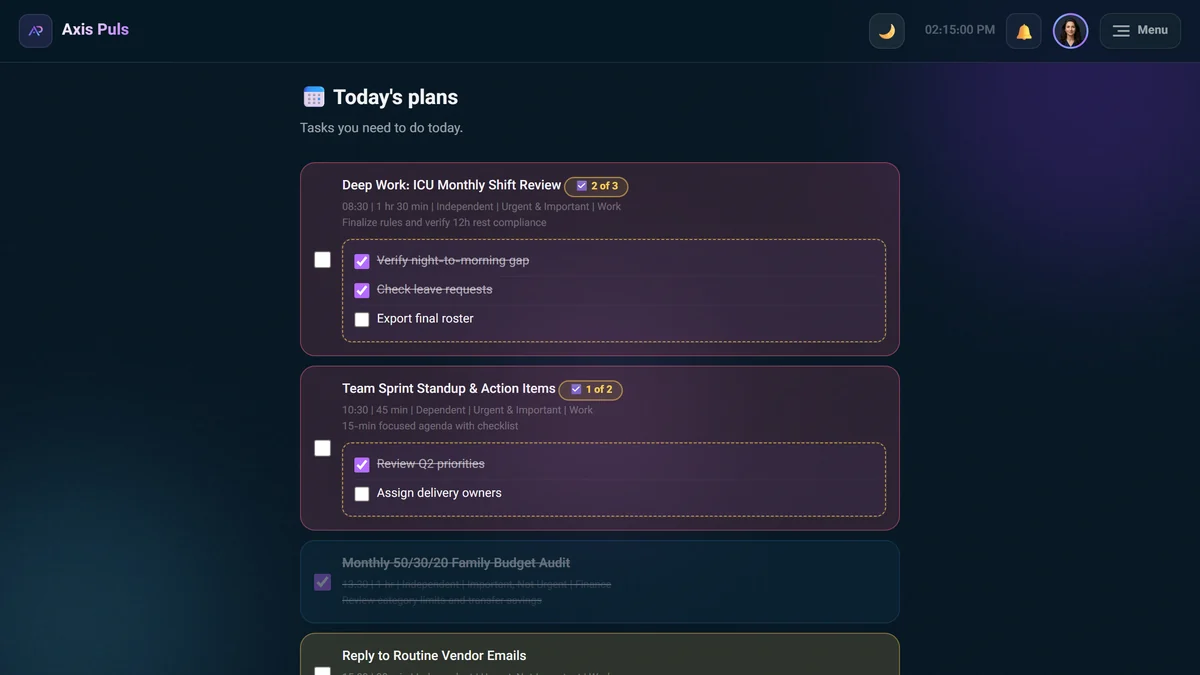
The Today page lists everything due today in time order; each needs one tick. The timeline visualizes gaps and overlaps.
Conflicting new routines trigger a warning at creation, so you slot habits into real gaps.
Morning (6:30–8:00): wake, 10-min stretch, breakfast sans phone, review 3 key tasks.
Work: start with the frog, two 50-minute focus blocks, log tomorrow at close.
Night (21:30–22:30): review today, prep clothes and bag, 15-min reading, sleep on time.
To connect this workflow with adjacent tools and real examples, explore Personal Planner, Eisenhower Matrix, Time-Blocking Guide, Weekly Planning, Smart Checklists, Group Planning.