- Definition: income means all money inflows over a period and spending means all outflows; balance = total income − total spending.
- Three winning habits: logging every transaction regularly, categorizing them correctly, and comparing results period over period.
- Budget: income and spending report the past, while a budget maps the future; keep both for financial peace of mind.
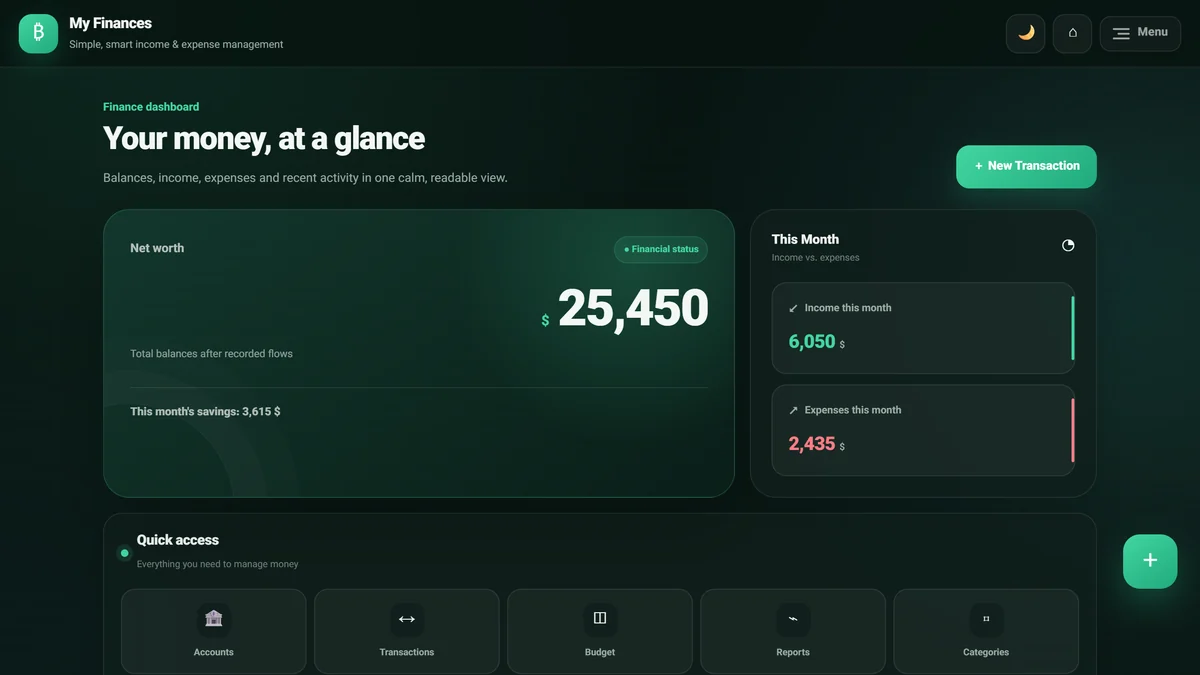
- Tool: According to the product docs, the Axis Puls finance module offers logging, categorization, budgeting and reporting in English with the Gregorian calendar.
What is income and spending?
Lasting financial control comes from small, repeatable habits: clear visibility into inflows, realistic caps on flexible spending, and paying savings goals first. Walk through the complete 5-minute system below.
Income and spending is a simple yet precise term for describing the flow of money in everyday life. “Income” means all the money entering your wallet, bank account or business over a period (usually a month), and “spending” means all the money leaving it. No more complicated definition is needed; these two numbers are the basis of all your financial decisions.
How do we manage income and spending?
Managing income and spending means building a simple, lasting logging system; an over-complex system gets abandoned, so start small: logging all revenue (salary, side income, bonuses and receipts; for seasonal income, look at bigger periods such as quarters), logging fixed costs (rent, installments, insurance and subscriptions that form the inflexible ceiling of the budget), logging variable costs (food, transport and daily spending where the biggest optimization opportunity lies) and categorizing expenses (housing and energy, food, transport, health, education, leisure, saving and debt, other). Amounts without categories are useless raw data. For systematic ways to cut spending, see the expense management article.
Log every money entry the moment it happens or that night; complete data is the precondition of analysis.
| Financial Control Criterion | Memory & Bank SMS Alerts | Paper Notebook or Manual Sheet | Personal Finance & Budget Tracker (Axis Puls) |
|---|---|---|---|
| Capturing Daily Micro-Spend | Cash tips and quick transfers vanish from memory | Waiting until laptop time at night leads to skipped days | Log in seconds on mobile across bank, cash, or wallet accounts |
| Category Budget Visibility | You only notice overspending once the balance hits zero | Requires manual summing and formula maintenance | Real-time progress against each monthly category ceiling |
| Separating Savings Goals | Rent money, daily coffee, and savings sit in one blurred pool | Hard to track multi-month target progress cleanly | Dedicated accounts plus named savings goals with target dates |
| Shared Bills & Group Splits | Awkward guesswork after roommate runs or group trips | Manual per-receipt spreadsheet math | Built-in payer logging and clean per-member settlement |
What should we do if spending exceeds income?
After several deficit months in a row, take four steps in order: spotting unnecessary costs (open the multi-month report and find grown discretionary categories), prioritizing expenses (cut the reducible tier first, not food and healthcare), reviewing income sources (side income and selling idle assets; the income management article helps) and fixing the budget (set each category's cap from the real average of past months, not guesses).
Households have several income sources and shared expenses, and without transparency they create friction. First define a shared monthly budget with everyone's participation; a credible starting point is Elizabeth Warren and Amelia Warren Tyagi's “50/30/20 rule” from “All Your Worth”: 50% needs, 30% wants and 20% saving and debt reduction — a framework to start with, not a fixed prescription; rent, inflation and family size make it different for every household in Iran. Record costs like rent and food as shared expenses in one place with transparent funding, and set an amount, deadline and periodic deposit for every financial goal (for example 12 million for a trip in 6 months, 2 million per month).
- The deficit's funding source is identified (previous savings or lower spending)?
- Discretionary categories that kept growing were identified?
- A realistic cap set for next month?
- A numeric financial goal with an amount and deadline is defined?
Managing income and spending with Axis Puls
According to the product docs, the Axis Puls finance module is English, left-to-right and Gregorian-based, turning income-and-spending logging into a few simple steps: logging transactions (type, amount in Toman, category and note), accounts and categories (cash, bank, card and crypto wallets with customizable categories), budgeting and saving goals (monthly caps per category with near-cap warnings, plus goals with amounts and deadlines), period reports and comparisons (balance dashboard, monthly revenue and expenses, trend charts, Excel export and backups) and a English, Gregorian experience on mobile and web. For deeper financial analysis, read the smart accounting article.
This page is based on credible sources: the 50/30/20 rule from Elizabeth Warren and Amelia Warren Tyagi's “All Your Worth”; the consumer.gov “Making a Budget” guide; the US Consumer Financial Protection Bureau's “Your Money, Your Goals” worksheets; and OECD financial-education programs on knowing your real income and expenses.
| Real User Situation | Common Emotional Trap | Sustainable Practical Response |
|---|---|---|
| Falling behind by mid-afternoon | Doubling tomorrow's workload and burning midnight oil | Prune low-value tasks immediately and rescue 1–2 core items |
| Setting monthly or quarterly goals | Writing vague wishes like 'get organized' with no calendar slot | Break each goal into concrete weekly milestones on your timeline |
| Running meetings or group plans | Open-ended calls with no agenda, owner, or stop time | Attach a 3-bullet agenda, hard end time, and action checklist |
| Choosing planning software | Juggling four complex apps until tool fatigue wins | Keep daily tasks, Eisenhower priority, and shifts in one place |
To connect this workflow with adjacent tools and real examples, explore Personal Finance Tracker, Personal Accounting, Family Budget Guide, Income Management, Cost Management.
❓ Frequently Asked Questions from Real Workflows
Know where your money goes starting today
Start logging, categorizing and budgeting in one English, Gregorian-calendar tool.
Start logging income and spending